First, Understand the "Why"
Bridging aggregators (like LI.FI, Socket, Squid, etc.) don't blacklist arbitrarily. It's usually for one of three reasons:
-
Suspicious Source of Funds: The assets in your wallet originated from a known scam, hack, mixer (e.g., Tornado Cash), or a sanctioned protocol. This is the most common reason.
-
Wallet Address on a Sanction List: Your wallet address itself has been added to a compliance blacklist (like OFAC's SDN list) due to its association with illicit activities.
-
Technical or Behavioral Flag: Unusual transaction patterns that resemble bot activity, spamming, or arbitrage exploitation can trigger temporary restrictions.
Step-by-Step Guide to Handling a Blacklist
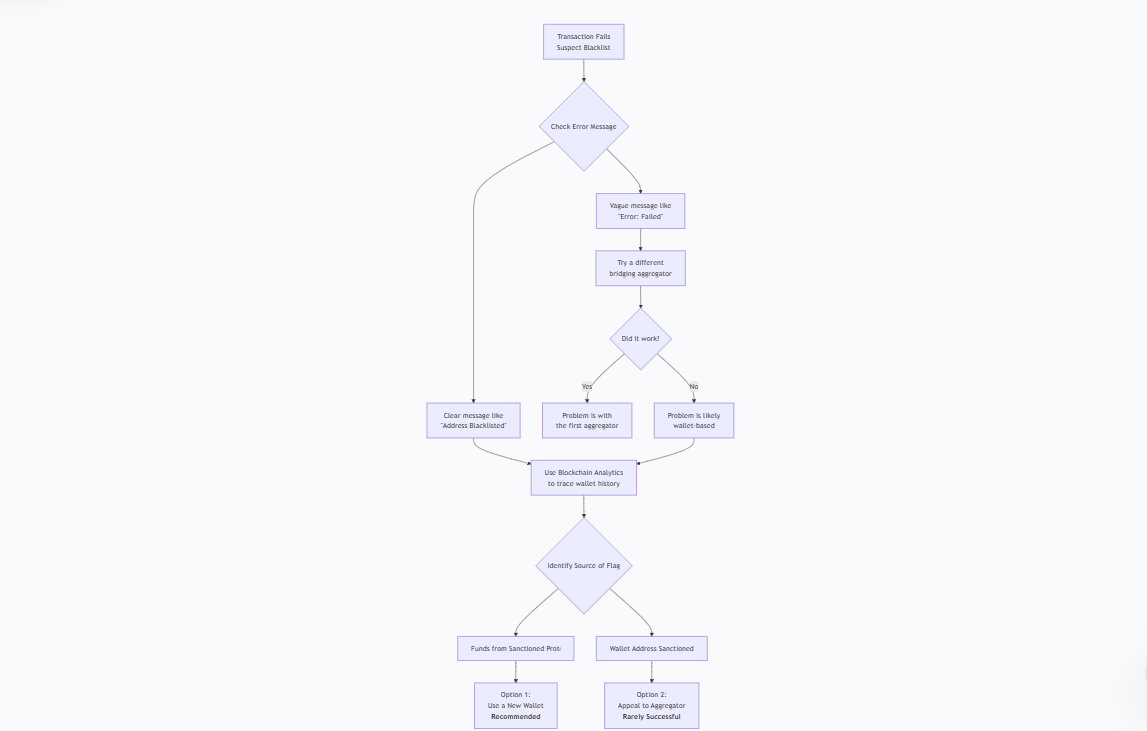
Follow this flowchart to diagnose and address the problem:
Step 1: Confirm You Are Actually Blacklisted
Don't assume. Look for evidence:
-
Error Message: The most direct evidence is an explicit error message like "Address blacklisted," "Compliance error," or "Restricted jurisdiction."
-
Transaction Failure: If the transaction consistently fails without a clear reason, especially when swapping small amounts, it's a strong indicator.
-
Test with a Different Aggregator: This is the most crucial diagnostic step. If your transaction fails on Socket, try the same swap on LI.FI or Squid.
-
If it works on another aggregator, the issue is specific to the first aggregator's compliance policies.
-
If it fails on all major aggregators, the problem is almost certainly your wallet address or the assets within it, and it's being read from a shared blacklist.
Step 2: Diagnose the Root Cause
If you've confirmed a blacklist, you need to figure out why.
-
Analyze Your Wallet's History: Use blockchain explorers (Etherscan, Arbiscan) and analytics tools (like Breadcrumbs, Arkham, Nansen) to trace the origin of your funds.
-
Did you receive funds from a protocol that was later sanctioned (e.g., Tornado Cash)?
-
Did you interact with a protocol that was hacked or deemed a scam?
-
Does your wallet show a pattern of high-frequency, bot-like trading?
-
Check Public Sanction Lists: While difficult for the average user, some services track flagged addresses. The aggregator is likely using an enterprise compliance API like Chainalysis, TRM Labs, or Elliptic.
Step 3: Choose Your Course of Action
Based on your diagnosis, here are your options, from most to least recommended.
Option 1: The Most Effective Solution – Use a New, Clean Wallet
This is the most straightforward and guaranteed way to solve the problem.
-
Create a Fresh Wallet: Generate a brand new wallet address (e.g., a new MetaMask wallet) that has never transacted before.
-
Bridge Funds via a Non-Aggregator Method: Use a canonical bridge (like the official Arbitrum, Optimism, or Polygon bridge) or a direct bridge (like Hop Protocol, Across) to transfer clean funds from your old wallet to the new one.
-
Crucial Point: The funds you send to the new wallet must be "clean." If you send funds that originated from a blacklisted source, you will contaminate the new wallet.
-
Use the Bridging Aggregator with the New Wallet: Your new wallet, holding cleanly bridged funds, should have no issues using any aggregator.
Why this works: The blacklist is tied to your wallet address, not you as a person. A new address starts with a clean slate.
Option 2: Appeal to the Bridging Aggregator (Long Shot)
If you believe the blacklisting is a mistake, you can try to appeal.
-
Find their Contact Info: Look for a "Support" or "Contact" link on their website or Discord server.
-
Provide Your Wallet Address: Clearly state your wallet address that is being blocked.
-
Be Polite and Professional: Explain that you believe this is an error and ask if they can provide the reason for the blacklist or re-evaluate your address.
Be prepared for:
-
No response (very likely).
-
A generic response citing "compliance reasons."
-
An inability to reverse the decision due to their reliance on third-party compliance data.
Option 3: Use Alternative Methods (Workarounds)
If you don't want to create a new wallet, you have less efficient options:
-
Canonical/Direct Bridges: Bypass the aggregator altogether. You'll lose the benefit of optimal routing and cost savings but can still move your assets.
-
Centralized Exchanges (CEXs): Use a CEX as an intermediary. Deposit the asset from Chain A to the CEX, then withdraw it to Chain B. This is often the "cleanest" way to break a fund's on-chain trail but involves KYC and fees.
-
Decentralized Exchanges (DEXs) on Destination Chain: Instead of bridging the token itself, you could bridge a stablecoin (if possible) and then swap for the desired token on a DEX on the destination chain.
How to Prevent Being Blacklisted in the Future
Prevention is always better than cure.
-
Be Extremely Careful with Your On-Chain Activity:
-
Avoid Interacting with Malicious Contracts: Use tools like Token Sniffer or Harvest.io to check a token or contract's safety before interacting.
-
Don't Accept "Airdrops" from Unknown Senders: Scammers often send tokens to wallets to see if someone will interact with their malicious contract. Leave them alone.
-
Be Wary of Mixers: Using privacy mixers like Tornado Cash will almost certainly get your address flagged on most compliant DeFi services.
-
Maintain a "Clean" Wallet: Use a multi-wallet strategy.
-
Wallet 1 (Vault): For long-term holdings and receiving funds from trusted sources.
-
Wallet 2 (DeFi Interaction): For active trading, yield farming, and interacting with new or experimental protocols. If this wallet gets flagged, it doesn't affect your main holdings.
-
Wallet 3 (Bridging): A relatively clean wallet used primarily for moving assets across chains via aggregators.
Summary
| Situation | Best Action |
|---|---|
| You suspect a blacklist | Test on a different aggregator (e.g., switch from Socket to LI.FI) to confirm. |
| Confirmed blacklist on one aggregator | Simply use a different aggregator. Their compliance filters differ. |
| Confirmed blacklist on all aggregators | Create a new wallet and bridge clean funds to it via a canonical bridge. This is the most reliable solution. |
| Believe it's a mistake | Contact the aggregator's support, but manage your expectations. Success is unlikely. |
The key takeaway is that in a decentralized world, your wallet address is your identity. Keeping that identity clean is essential for seamless access to the best DeFi services.