A deployed token is not a tradable token
You deploy a token, open your wallet, and see a balance with no price attached. You paste the contract into a DEX and nothing comes up. The first guess is usually "the contract is broken." Most of the time it isn't. A token has no price of its own—the price lives in a trading pair, and a pair only exists once someone puts both the token and BNB (or USDT) into a pool. Without a pool, your token is a contract that can transfer and nothing else.
Two different "no price" problems
The first: there is no pair on the DEX at all. Paste the contract address into PancakeSwap or any other DEX. If nothing comes up, you never created a pool—or it was created on a different chain.
The second: the pair exists, but your wallet shows no price. That has nothing to do with the pool. Wallet prices come from external market feeds, and new tokens usually need some trading history before they appear. You can trade fine—it just looks bad for a while.
Cause 1: There is no liquidity pool
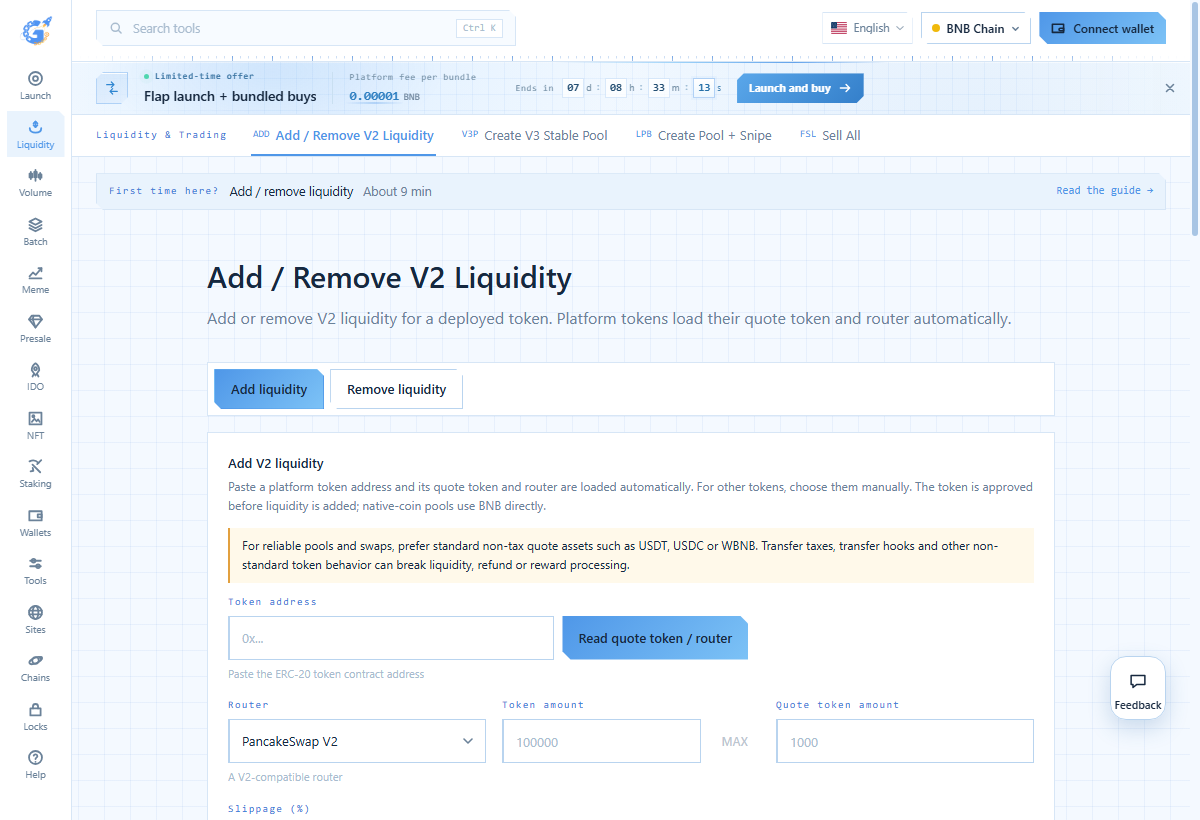
Deploying a token does not create liquidity. To make it tradable you have to build the pool yourself: pick a base asset (BNB or USDT on BSC), seed both sides at the ratio you want, and that ratio becomes the opening price.
One detail people miss: the transaction that creates the pool is visible to snipers. Getting front-run on the first block is common. If you also want to buy at launch, create the pool and buy in the same block so nobody can jump the queue.
Cause 2: One-sided or shallow pool
Put in tokens but no BNB and there is no quote—that's not a pool, it's a deposit. Put in too little on both sides and the price is unusable: buy a little and it flies, sell a little and it craters. It looks like "no price," but the real problem is depth.
Adding, removing, or switching the base asset all happens in add liquidity, which reads the base asset and the route automatically for tokens launched on the platform.
Cause 3: The contract blocks selling
Pool works, buying works, selling fails. That's the contract, not the pool. Four usual suspects: trading not enabled, sell tax cranked up, your address blacklisted, or the transfer function was rewritten (a honeypot).
The test takes a minute: buy a small amount from a second wallet, then try to sell. Can buy, can't sell—contract restriction. And it can't be patched after deployment. Your only option is to launch again. When you do, use the token creator with a standard token and skip the tax and the extra switches.
Check in this order
Step 1: search the contract on a DEX. A missing pair points to "no pool"; an existing pair points to "contract issue."
Step 2: look at pool depth. Open the pair info and check how much base asset is locked in the LP. If it's thin, top it up.
Step 3: buy and sell a small amount. Buys fine, sells fail or get taxed to death—that's the contract layer.
Lock the LP once it trades
Pool is live and the price looks right. One more thing: as long as the LP sits in your wallet, holders assume you can pull it at any moment, and they stay away. Lock it with LP liquidity lock, pick a duration, and nobody can remove it while the lock runs. That's what gives buyers confidence.
FAQ
Can I sell a token with no liquidity pool?
No. With no pair there is no price and no counterparty—the token can only be transferred.
How much should I put in the liquidity pool?
It depends on the volume you expect. Too little and one decent buy sends the price flying; one sell craters it. Size it against your budget and expected turnover instead of making the pool as cheap as possible.
Can I remove liquidity after adding it?
Yes, as long as the LP is in your wallet. But pulling it takes the price to zero and tells every holder you're gone. If you plan to stay, lock the LP.
What if I deployed on the wrong chain?
Deployment can't be moved. Redeploy on the target chain—the old address can't be migrated.
The token isn't broken. It's just sitting in its contract, outside the market. Build the pool, give it depth, lock the LP—then it's actually live.