Most people think launching a token on BSC costs a fortune—they're wrong.
The biggest misconception I see is that you need deep pockets to create a token on BNB Chain. In reality, the platform fee is 0.05 BNB on BNB Chain, plus gas. But that's just the tip of the iceberg. The real expenses come from what you do after deployment: liquidity, marketing, and ongoing operations. If you're only looking at the deployment fee, you're missing the bigger picture.
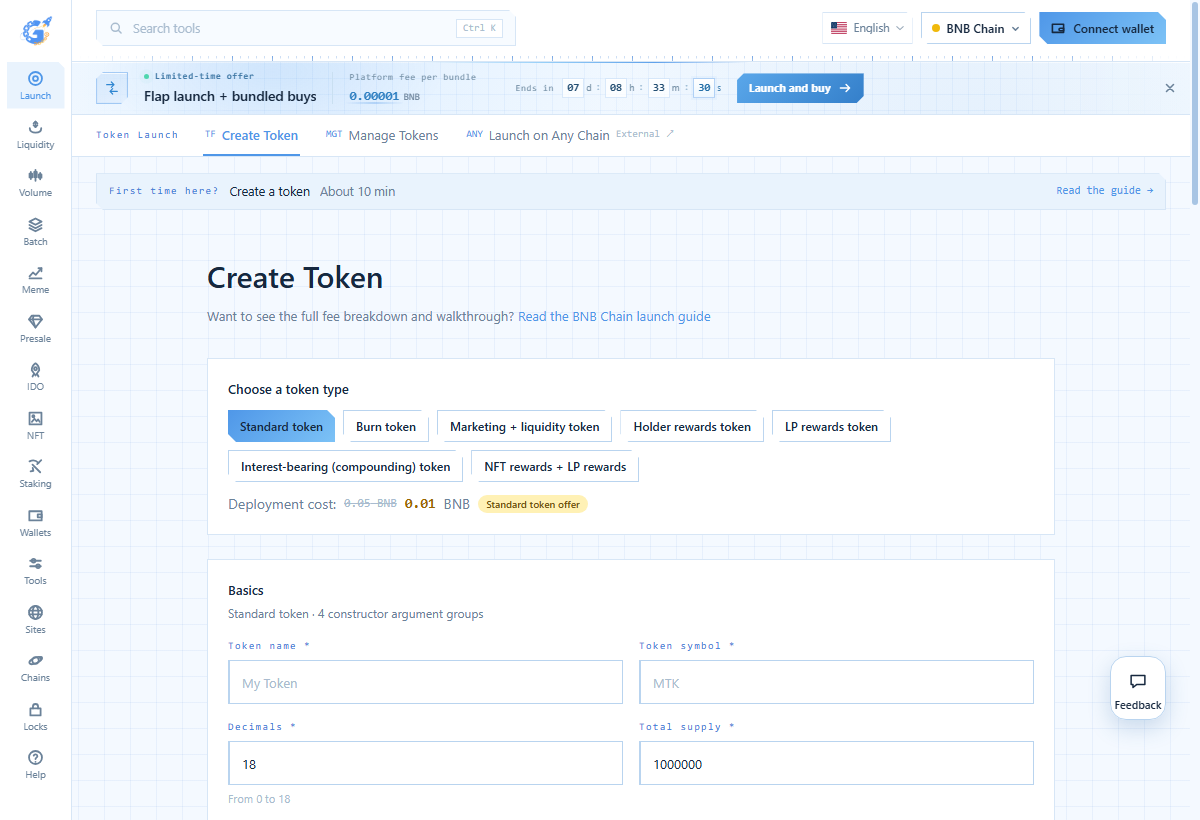
Reason 1: Platform fees are just the entry ticket
Using a no-code tool like GTokenTool, you'll pay a service fee of 0.05 BNB. Standard, marketing-rebate, holder-dividend, LP-dividend, interest-bearing and NFT-dividend tokens all cost the same. Burn-dividend tokens are the exception: no upfront fee, but 0.25% of every trade is taken on-chain. The page may run a limited-time 0.01 BNB promo for standard tokens—check the creation page for the current price. That's cheap. But don't confuse this with the total cost. The platform fee pays for a standard, widely used contract and a simple form. Gas is separate and moves with network congestion; your wallet shows the exact figure before you sign.
More importantly, the platform fee buys you a standard ERC-20 token with no bells and whistles. If you want advanced features like automatic liquidity or holder dividends, the deployment fee is the same, but the token itself carries a trading tax. But even then, the fee is negligible compared to what comes next.
Reason 2: Liquidity is the real money sink
Creating a token without liquidity is like opening a store with no products. You need to add liquidity to a DEX like PancakeSwap to make it tradable. And here's the kicker: you can't just add $100 and expect it to work. You need enough liquidity to handle trading volume and avoid wild price swings. Most projects start with at least a few thousand dollars, and that's on the low end. The capital you lock in the pool is your own, and that's where most of the money goes.
Plus, if you want to lock liquidity to build trust, you'll pay for that service too—either through a third-party locker or a built-in tool. These costs add up quickly.
Reason 3: Marketing and community building are ongoing costs
Even the most technically perfect token will go nowhere without an audience. You'll need to budget for marketing: social media, influencer shoutouts, listing fees on aggregators, and maybe even a small ad campaign. These costs are highly variable but can easily dwarf the deployment fee. I've seen projects spend thousands on marketing for a token that cost one deployment fee to launch. That's the reality: the token is cheap; the attention is expensive.
The counter-argument: "But I've seen tokens launch with almost no money!"
Yes, you can deploy a token for one small platform fee plus gas. But those tokens rarely gain traction. The successful ones almost always have liquidity and marketing behind them. The low barrier to entry is a feature, not a bug—it lets you experiment, but it doesn't guarantee success. If you're serious about a project, you must plan for the full cost, not just the deployment.
What to do: budget for the whole journey
Start by calculating your total budget: platform fee + gas + initial liquidity + marketing. Use a tool like GTokenTool's one-click token creator to get a clear picture of the deployment cost. Then, set aside at least 80% of your budget for post-launch activities. Don't skimp on liquidity—it's the lifeblood of your token. And remember, the cheapest option isn't always the best; sometimes paying a bit more for a feature like automatic dividend distribution can save you headaches later.
Final thought: The cost of a token is small; the cost of a failed launch is huge.
FAQ
How much does it cost to create a token on BSC?
The platform fee is 0.05 BNB on BNB Chain, plus gas. Burn-dividend tokens charge 0.25% per trade instead of an upfront fee. A limited-time 0.01 BNB promo may be running—check the creation page for the current price. You'll also need budget for liquidity and marketing.
What are the hidden costs of launching a token on BSC?
Beyond deployment, you must add liquidity to a DEX (often thousands of dollars), pay for liquidity locking if desired, and cover marketing expenses. These ongoing costs far exceed the initial creation fee.
Can I create a token on BSC without coding?
Yes, using no-code platforms like GTokenTool. You fill out a form, connect your wallet, and deploy. The platform handles the smart contract, and you only pay the service fee and gas.
What is the gas fee for deploying a token on BSC?
Gas fees vary with network congestion and are usually low on BSC. You can check current gas prices on BscScan, and your wallet shows the exact amount before you sign.
How much liquidity do I need for a new token?
There's no fixed minimum—it depends on the volume you expect. Thin liquidity means wide swings; more liquidity means a smoother trading experience and lower slippage.