Introduction
In the world of cryptocurrency, newcomers often notice a strange phenomenon: some newly launched tokens suddenly explode in trading volume and their price shoots up in a straight line, as if they became "star coins" overnight. Behind this, there is often a crucial tool – the market making bot.
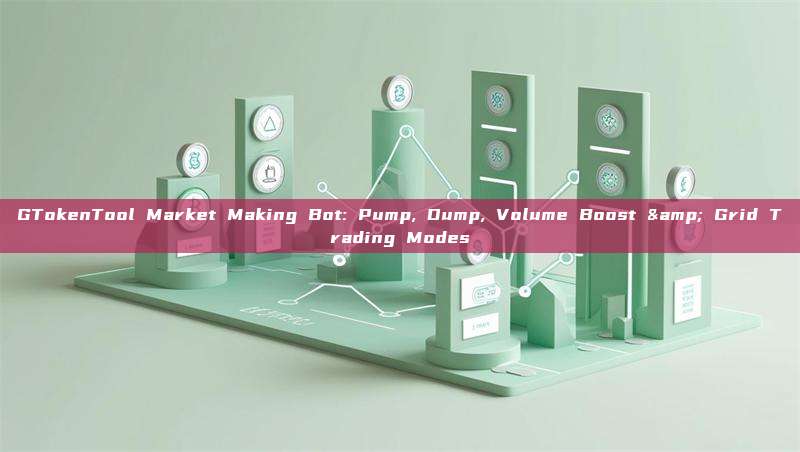
GTokenTool is a powerful all-in-one token creation and quantitative trading platform in the crypto space, specifically designed for automated quantitative trading on decentralized exchanges (DEXs). It supports four core modes: Pump, Dump, Volume Boost, and Grid Trading (Buy Low, Sell High). These modes help project owners, market makers, or traders efficiently manage a token’s market cap, liquidity, and trading depth. Whether you are a project owner who just launched a token or a newbie trader trying to learn market making, understanding these four modes is the first step.
This guide will start from scratch and break down the meaning, operating principles, and use cases of each mode in simple terms. We’ll use a side-by-side comparison table and a FAQ section to help you thoroughly understand their differences.
Pump Mode: Continuously buys to push the price up. The goal is to "create hype and attract attention."
Dump Mode: Continuously sells to drive the price down. The goal is to "cash out and exit" or "shake out weak hands to accumulate."
Volume Boost Mode: Rapidly buys and sells back and forth. The goal is to "create an illusion of high activity" without significantly changing the price.
Grid Trading Mode (Buy Low, Sell High): Repeatedly buys low and sells high within a set price range. The goal is to "steadily arbitrage the spread."
Let’s dive deep into each one.
I. What is the GTokenTool Market Making Bot?
The GTokenTool Market Making Bot is an automated trading tool based on blockchain technology. It primarily targets token projects on major public chains like Solana, Ethereum, and BSC to manage their market cap. It uses smart algorithms to execute automated buy and sell orders, inject liquidity, stabilize prices, and optimize a token's circulation and market performance.
In simple terms: think of it as an "automatic trading manager." In the past, manipulating a token's price required manually staring at candlestick charts and switching back and forth between different wallets. That was inefficient and error-prone. A market making bot allows you to import dozens or even hundreds of wallets at once and automatically execute trades according to your preset strategy, with zero manual intervention needed.
The four core modes supported by the bot—Pump, Dump, Volume Boost, and Grid Trading—each correspond to different market goals and tactics. Let's look at them one by one.
II. Pump Mode: Rapidly Boost the Price to Generate Hype
Pump Mode pushes up the market price by continuously buying the token. The goal is to make the price surge rapidly in a short period, attracting market attention and FOMO-driven retail money.
The pump is one of the most commonly used modes, especially perfect for meme coins or newly launched tokens that need to quickly build hype.
How it works: The user sets a target price (which must be higher than the current market price), chooses the buy amount or quantity, and sets the transaction interval (default is 8–15 seconds). The bot then automatically buys the token in batches through multiple wallets, continuously driving the price up. Pump Mode pushes the price up by buying tokens; the target price must be higher than the current token price.
Key Parameters:
Buy Amount Calculation: You can choose a fixed amount or a random range. If you fill in a range (e.g., 0.01–0.05 BNB), the bot will randomly buy within that range, mimicking organic buy orders.
Target Price: The bot automatically stops when the target price is reached.
Time Interval: The number of seconds between each buy. A shorter interval means a faster pump.
Multi-Wallet Coordination: This is key to making the pump look "natural." It supports dozens of wallets buying simultaneously, which simulates a rush of real retail traders and avoids being targeted by snipers as a single large order.
Ideal Use Cases: Creating initial hype for a new token, project owners defending a price floor, or pumping the price alongside positive announcements. The effectiveness of a pump depends heavily on the combination of capital, number of wallets, and strategy parameters—too little capital won't move the price, and too few wallets can be easily detected as wash trading. That's why project owners usually prepare sufficient market-making funds and multiple wallet groups before starting a pump.
III. Dump Mode: Sell Off Quickly to Lower the Price
Dump Mode drives the market price down by continuously selling the token. The goal is to crash the price in a short period—either to take profits and exit, or to accumulate at lower prices.
Dump Mode is the "evil twin" of Pump Mode. If Pump Mode is hitting the gas, Dump Mode is slamming the brakes. Dump Mode lowers the price by selling tokens; the target price must be lower than the current token price.
How it works: The user sets a target price lower than the current price and enters the number of tokens they want to sell. The bot then automatically sells in batches through multiple wallets. In Dump Mode, you set the number of tokens to sell, not the buy amount.
Key Parameters:
Sell Quantity: In Dump Mode, you input the number of tokens, not the amount of native coins.
Target Price: The system automatically stops selling once the set low price is reached.
Dispersing through Multiple Wallets: This is also a core strategy. If you dump a huge number of tokens from a single wallet, the candlestick chart will show an obvious "big red dildo," easily identified as a malicious dump. Dispersing the sell-off in small batches through many wallets makes the decline look more "natural."
Ideal Use Cases:
Taking Profits: After a successful pump, lock in profits by dumping.
Shaking Out Weak Hands: A dump creates panic, causing retail traders to sell at a low price. The big players then take the opportunity to collect cheap tokens.
Testing Depth: Using a small number of tokens to dump and test the market's buy-side depth as a reference for future moves.
Risk Warning: If a dump is too intense and too fast, it can trigger a market-wide panic sell-off, potentially causing the token price to collapse or even go to zero. Project owners must carefully control the pace.
IV. Volume Boost Mode: Create an Illusion of Booming Activity
The core goal of Volume Boost Mode is not to change the price, but to generate a massive amount of trading records, making the token look highly active and popular, thus attracting real investors.
This is a point where many beginners get confused—they think boosting volume is about pumping the price. In reality, Volume Boost Mode pursues "volume," not "price action."
How it works: The bot generates a large number of transaction records by randomly buying and selling. Users can set the number of wash trading rounds and the interval between them. The bot quickly buys and sells within a tiny range. Each transaction amount is small, but the frequency is extremely high, generating a flood of on-chain transaction records in a short time.
Key Settings:
Buy/Sell Amount Range: Set a random range for buy and sell amounts, e.g., 0.001–0.01 BNB each time. This ensures each transaction looks like a natural retail trader's activity.
Wash Trading Rounds and Interval: You can set the total number of rounds and the interval between each round.
Why Boost Volume? In the world of DEXs, trading volume is a core metric of a token's "activeness." DEX leaderboards and popular data analysis tools like DEX Screener rank tokens based on trading volume. If a new coin has zero transaction history for several minutes straight, retail traders won't even notice it. By boosting volume, the token rapidly increases its trading activity, helping it gain better exposure and ranking on DEXs.
The more volume you generate, and the more natural it looks, the more likely the token is to be pushed to the "Hot Pairs" list by algorithms, bringing in genuine organic traffic. Boosting volume also helps meet the listing requirements of centralized exchanges (CEXs)—many exchanges require a token to have a certain average daily trading volume on DEXs before they will consider listing it.
V. Grid Trading Mode (Buy Low, Sell High): Automated Arbitrage for Steady Profits
Grid Trading Mode automatically "buys low and sells high" within a set price range, repeatedly earning the spread as profit. It's similar to "grid trading" in traditional finance.
Grid Trading is the most technically sophisticated of the four modes and carries the lowest relative risk. It's well-suited for volatile tokens during long-term automated market making.
How it works: The user sets a low-price buy threshold and a high-price sell threshold. The bot monitors the price range like a smart hunter: when the price dips to the low threshold, it automatically buys; when it peaks to the high threshold, it automatically sells, steadily generating profit. Grid Trading Mode is all about using natural price fluctuations to "scalp the spread"—buy when it drops, sell when it rises, repeating the cycle within the predefined range.
Key Parameters:
Low Buy Threshold: When the price falls below this value, the bot initiates a buy.
High Sell Threshold: When the price rises above this value, the bot initiates a sell.
Parallel Multi-Wallets: Supports multiple wallets participating in the grid simultaneously, maximizing capital utilization and arbitrage coverage.
The Difference from Volume Boost Mode: This is the mix-up most beginners make. The biggest difference: Volume Boost does not pursue spread profit, and may even lose money on fees; the core goal of Grid Trading is to earn the buy-sell spread. Boosting volume is about creating "fake data"; grid trading is about earning "real profits." Additionally, Grid Trading usually involves larger single transaction amounts and longer intervals, while Volume Boost is a high-frequency, small-amount "lightning" mode.
Ideal Use Cases: Long-term market making is needed after a token launch to maintain price stability while earning arbitrage returns; or when a token enters a sideways consolidation phase, using Grid Trading to continuously profit.
VI. Core Differences Between the Four Modes – A Data Comparison
The table below compares the four modes side-by-side across seven dimensions: core purpose, price direction, trade frequency, single trade size, profit source, ideal stage, and risk.
| Comparison Dimension | Pump Mode | Dump Mode | Volume Boost Mode | Grid Trading Mode |
|---|---|---|---|---|
| Core Purpose | Rapidly pump the price, generate hype | Rapidly dump the price, exit or shake out | Generate massive trade records, boost ranking | Repeatedly arbitrage using price swings |
| Price Direction | ⬆️ Upwards | ⬇️ Downwards | ➡️ Largely unchanged (tiny range oscillation) | ↕️ Repeated fluctuations within range |
| Trade Direction | One-way Buy | One-way Sell | Two-way (rapid buy & sell) | Two-way (buy low, sell high) |
| Trade Frequency | Medium (8-15 sec intervals) | Medium | Extremely High (high-frequency micro-transactions) | Low (waits for price triggers) |
| Single Trade Size | Larger | Larger | Very Small | Medium |
| Profit Source | Unrealized gains from price increase | Selling for profit or positioning low | No direct profit (may lose on fees) | Profits from the bid-ask spread |
| Wallet Requirement | Multiple (simulate real buy pressure) | Multiple (disperse sell pressure) | Multiple (increase unique trader count) | Small number possible |
| Ideal Stage | New token launch, riding positive news | Profit-taking, shakeout & accumulation | Boosting DEX ranking, fulfilling CEX listing requirements | Sideways/consolidation phase, long-term market making |
| Market Price Impact | Significantly pushes price up | Significantly pushes price down | Minimal | Has a stabilizing effect |
| Risk Level | ⭐⭐⭐ Medium | ⭐⭐⭐⭐ Higher (risk of triggering a stampede) | ⭐⭐ Low (main cost is transaction fees) | ⭐⭐ Low (needs the right market conditions) |
VII. Q&A
Q1: What’s the difference between the Pump and Volume Boost modes? This is the easiest mix-up for beginners.
The Pump mode's core goal is to push the price up. It achieves this through continuous buys, so the trade direction is one-way. Volume Boost's goal is to generate transaction records without chasing a price change, so it buys and sells simultaneously within a tiny range. Simply put: With Pump mode, you look at "how much the price went up." With Volume Boost, you look at "how many transactions were made."
Q2: Can I run the four modes at the same time?
No, you cannot run them simultaneously. The GTokenTool quantitative trading bot offers four modes, and you can only pick one at a time to start automated trading. However, users can switch between modes in different phases based on market conditions—for example, first using Pump Mode to attract attention, then switching to Grid Trading Mode for stable arbitrage.
Q3: Which mode should a total beginner start with?
We recommend starting with Pump Mode. It is the most common and intuitive mode, and the parameter settings are relatively straightforward. First, practice on a Solana or BSC testnet with a small amount of capital to get familiar with the pump parameters (interval time, amount, target price). Once you're comfortable, gradually try the other modes. Absolutely do not jump in with large capital right away, as incorrect parameter settings can easily cause unnecessary losses.
Q4: Why is multi-wallet operation so important?
If a single wallet buys a huge amount, other users can simply check a blockchain explorer and immediately see that "this is one person pumping." Real retail traders will become suspicious and stay away. By dispersing operations through dozens of wallets, with each wallet buying a little bit, the on-chain data looks like many different people are trading. This is much more credible and far more effective at attracting genuine FOMO money.
VIII. Summary
The four core modes of the GTokenTool Market Making Bot each serve a distinct function, forming a complete toolbox for token market cap management:
Pump Mode is responsible for "hype generation"—rapidly driving up the price to capture the market's attention.
Dump Mode is for "the exit or the setup"—selling for profit or creating panic to accumulate at a lower price.
Volume Boost Mode is for "dressing up the shop window"—manufacturing a facade of bustling trading activity to gain better DEX exposure and ranking.
Grid Trading Mode is for "stable operations"—arbitraging long-term within price swings to maintain token liquidity.
For a project owner, a common operational path is: Launch Token → Create Liquidity Pool → Boost Volume to pump the metrics → Pump Mode to generate hype → Grid Trading for long-term market cap maintenance → Dump Mode at the right time to take profits. Of course, the timing and intensity of each step must be flexibly adjusted to market conditions. There is no one-size-fits-all "magic formula."