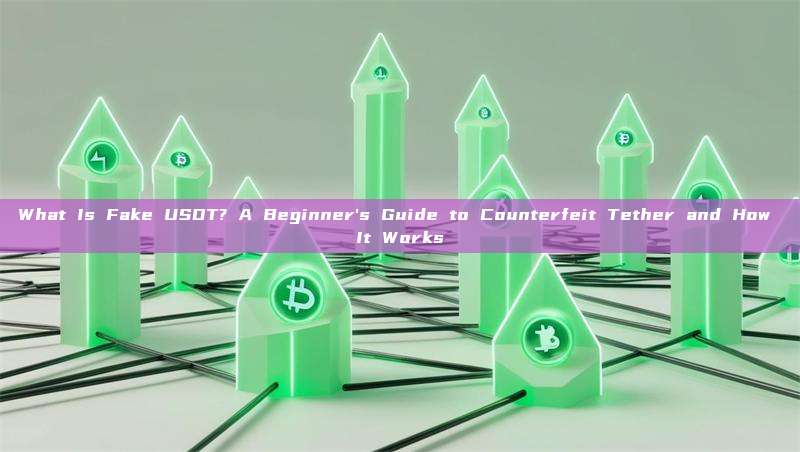
Fake USDT, often called "fake U" in crypto slang, refers to counterfeit Tether tokens not issued by Tether Limited, meaning they are not backed 1:1 by actual US dollars. The scam works by exploiting smart contract blacklist functions, spoofed token contract addresses, or wallet display glitches to create the illusion you've received real money. Unlike genuine USDT, fake USDT can never be cashed out on a legitimate exchange and can be frozen or zeroed out by the scammer instantly. The single most effective defense is refusing off-exchange peer-to-peer transfers and making it a habit to verify the contract address on a block explorer like Tronscan or Etherscan before accepting any transaction.
1. Introduction: When a Windfall Turns Out to Be a Trap
Picture this: you need to swap some cash into USDT. Someone slides into your DMs in a Telegram or Discord group, offering a rate way better than any exchange, plus "zero fees." You're skeptical but wire the money anyway. They fire back a screenshot of a completed transfer, and sure enough, your wallet now shows a shiny new balance of "USDT."
You think you've just scored a deal. But when you try to move those tokens onto Coinbase or Binance to cash out, the deposit fails. Or worse, you open your wallet the next day and the balance has vanished. Your real money is gone too.
You didn't stumble onto a bargain. You walked headfirst into one of crypto's nastiest scams: fake USDT.
For anyone new to Web3, understanding how fake USDT works matters more than learning how to buy your first Bitcoin. Buying the wrong coin gets you a bag you're stuck holding. Receiving fake USDT means your principal goes to zero in seconds. This article breaks down the entire con, layer by layer, in plain English.
2. What Is Fake USDT? Rethinking That Little "Equals" Sign
To understand the fake, you have to understand the real thing first.
Real USDT is issued by Tether Limited on major blockchains like Ethereum and Tron. It's a smart contract token backed 1:1 by reserves the company holds in the bank. Its defining traits: the contract address is public, verifiable, globally transferable, and redeemable for roughly one US dollar on every major exchange, everywhere.
Fake USDT, in simple terms, is a knockoff token that copies the name, ticker symbol, and sometimes even the logo of Tether. It has zero connection to Tether Limited and zero dollars sitting in a bank account backing it up.
Here's an analogy that clicks for Americans:
-
Real USDT is like a crisp hundred-dollar bill fresh from the US Treasury. It has security features, and every store in the country accepts it.
-
Fake USDT is like a Dave & Buster's Power Card. Inside that specific arcade, the machine says you've got a hundred bucks in credits. But try buying groceries with it at Walmart, and the cashier is going to look at you like you've lost your mind.
The cruelty of the scam lies in how it exploits blockchain's transparency and a blind spot most newcomers have: checking the name and logo, but never the underlying code. Anyone with a few bucks worth of TRX can mint a token on Tron, name it "Tether USD," and give it the symbol "USDT."
3. How Fake USDT Actually Works: It's Not Tech Wizardry, It's Sleight of Hand
Victims often wrestle with one question: "If crypto is decentralized and I can see the money in my wallet, how can it be fake?" Scammers typically rely on three technical tricks.
1. The Impersonator Contract: A Wolf in Sheep's Clothing
This is the most low-effort but widespread method.
The scammer mints a new token on Tron (TRC-20) or BNB Smart Chain (BEP-20). They set the Name to Tether USD, the Symbol to USDT, and even match the decimal precision.
When you go to deposit this token on a real exchange, the exchange's system reads the contract address, not the cosmetic name. Since that address doesn't match Tether's official one, the exchange instantly rejects it as an invalid token. But inside a decentralized wallet, the software often only displays the ticker name. It shows up right in your asset list as "USDT," and your brain checks the box that says the money arrived.
2. The Black Hole Permissions: Backdoors and Blacklists
This is the part that really messes with people's heads. Real and fake USDT have one critical difference buried in their code: admin keys.
-
Real USDT: Tether has the power to freeze addresses tied to criminal activity, but this requires a legal process and compliance steps. It practically never touches ordinary, lawful users.
-
Fake USDT (the sophisticated kind): The scam contract is deployed with a malicious set of owner privileges. The scammer can alter any wallet's balance at will or permanently blacklist an address from moving tokens.
The con plays out like this: -
Scammer sends you 1,000 fake USDT.
-
You see the balance, believe it's real, and wire them $1,000 in real money.
-
The second your wire transfer clears, the scammer taps a button in the contract backend — "freeze" or "burn." Those digits in your wallet instantly disappear.
This type of token is often called a "honeypot" or "goldfish coin." It only swims one direction. You can buy it, but you can never sell it.
3. The Ghost in the Memo Field
This one's rampant on the Tron network. A Tron transaction has a memo or data field. The scammer sends you a fraction of a cent worth of TRX and types "Sent 1,000 USDT" into that memo.
Some poorly coded wallets or platforms parse the memo field before checking actual on-chain asset movement. The user interface literally displays "You received 1,000 USDT." In reality, not a single token moved. It's a pure UI bug being exploited by a malicious actor.
4. Real USDT vs. Fake USDT: Side-by-Side Comparison
Here's a quick-reference table showing the gulf between the two:
| Criteria | Real USDT (Genuine Tether) | Fake USDT (Counterfeit) |
|---|---|---|
| Issuer | Tether Limited (official) | Anonymous scammers — literally anyone |
| Core Contract Address | A single, unique address verified by Tether and every exchange | Random, unverified addresses generated constantly |
| Value Backing | 1:1 peg to USD, backed by reserves, under regulatory scrutiny | Zero backing — pure vaporware |
| Liquidity (Cash-Out Ability) |
Extremely high Instant swaps on all major exchanges with deep order books |
Zero Can't be deposited on any reputable exchange; only good for scamming the next victim |
| Admin Privileges | Only freezing of suspicious addresses, governed by legal process; cannot alter balances | Scammer holds super admin keys: unlimited minting, arbitrary burning, balance manipulation |
| Block Explorer Status | Verified open-source contract, massive holder count, high transaction frequency | Often flagged "Unverified," "Contains Risk," or "Owner Privileges Not Renounced" |
| Gas Fee Behavior | Requires native token for gas (ETH, TRX, etc.) | Also requires gas; some scam variants even trick victims into paying inflated gas fees for worthless tokens |
5. Where Newbies Get Burned: The Four High-Risk Scenarios
Scammers don't list fake USDT on Coinbase. They hunt in unregulated gray zones:
-
The Over-the-Counter (OTC) Whales' Trap:
Scammers pose as big-time OTC desks in Telegram, WhatsApp, or WeChat groups. They specifically target people looking to move large sums. The bigger the amount, the less likely the victim is to do due diligence, assuming it's too much hassle. That assumption costs them everything. -
The Pig Butchering / Romance Scam Cash-Out:
A charming stranger online helps you "invest" and shows you a sleek platform with a fat USDT balance. When you try to withdraw your "profits," customer support demands a "tax" or "verification deposit" first. It's all a digital puppet show. The tokens and the platform are fake. -
Airdrop Phishing and Blind Signing:
Random, unsolicited USDT lands in your wallet, along with a link promising "Swap here to claim your reward." The moment you connect your wallet and sign that transaction, you're not just dealing with a fake token — you're likely approving a malicious contract that drains every real asset you hold. -
The "Black USDT" Mix-Up:
Seasoned traders worry about "black USDT" — real Tether flagged and frozen by law enforcement. Newcomers, however, usually encounter pure counterfeits. Scammers blur the lines intentionally, whispering, "I can sell it to you cheap because the source isn't exactly clean." This makes victims lower their guard about verifying the contract address, chalking up red flags to "dirty money" instead of "fake money."
6. How to Protect Yourself: The One Move That Kills the Scam
No matter how good the forgery looks on the surface, the code underneath cannot lie. As a newcomer, master these steps and you'll dodge 99% of fake USDT attempts:
-
Step 1: Never Trust a Screenshot
Old-school scammers love sending you a screenshot of a wallet. Screenshots can be Photoshopped. Even unedited, a fake token looks identical to the real thing in most wallet UIs. A screenshot is not proof of payment. Ever. -
Step 2: Worship the Contract Address — The Only ID That Matters
Before you accept a transfer, ask the sender directly: "What's the contract address for this USDT?" Then you go check it yourself on a block explorer.If what you see is not a 100% character-for-character match with the correct address above, it is a counterfeit. One wrong digit, one missing letter — it's fake.
-
Tron (TRC-20): Go to Tronscan. The real USDT contract is, and can only be:
TR7NHqjeKQxGTCi8q8ZY4pL8otSzgjLj6t -
BNB Smart Chain (BEP-20): Go to BscScan. The real address is:
0x55d398326f99059fF775485246999027B3197955 -
Ethereum (ERC-20): Go to Etherscan. The real address is:
0xdAC17F958D2ee523a2206206994597C13D831ec7 -
Step 3: The Test Transaction — Slow Is Smooth, Smooth Is Fast
No matter how much you trust an OTC contact, for any large amount, demand they send a tiny test first — one USDT, or even a fraction. You then immediately try to deposit that single token into your Binance, Coinbase, or Kraken account. -
If it deposits and shows up in your trading balance, it's real.
-
If it never shows up, or you get a "deposit failed" notice, terminate the trade immediately. You just saved your entire stack for the cost of one dollar.
-
Step 4: Run from Unverified and High-Permission Contracts
On Tronscan or BscScan, if the token page shows a red shield warning, or says "Contract Source Code Unverified," "Owner Privileges Not Renounced" — block that address and forget it exists. Real USDT contracts are open-source and have tightly governed admin powers.
7. Fake USDT FAQ
Q1: Can I deposit fake USDT into Binance, Coinbase, or Kraken?
A: Absolutely not. An exchange's deposit system matches incoming tokens against an approved list of official contract addresses. A fake token's address won't match, so the system labels it an "invalid token." The deposit simply won't process, and recovery is usually impossible. This is the fastest, most brutal test of authenticity.
Q2: I received some random, unsolicited USDT. I'm afraid to touch it. Can it hurt me just sitting there?
A: A token sitting idle in your wallet generally can't drain your other assets on its own. The real danger is curiosity. Many of these airdrops come with a link: "Go to ThisDodgySite.io to swap." The moment you visit, connect your wallet, and approve a transaction, that malicious contract can sweep every real coin you own. Best practice: hide the token in your wallet and pretend you never saw it.
Q3: I've heard the term "multisig USDT." Is that fake USDT?
A: No, and mixing these up is a common mistake. A multisig wallet requires multiple signatures to approve a transaction. It's a security setup, and the USDT inside it can be 100% real. "Fake USDT" means the token contract itself is counterfeit. Don't assume a multisig trade is a fake token trade, and vice versa.
Q4: Why would anyone buy fake USDT? What's its actual purpose?
A: The overwhelming majority of people "buying" fake USDT are victims who thought they were buying the real thing. The tokens have two primary uses: first, as a pure scamming tool to extract real fiat currency from marks. Second, as fake "profit" numbers displayed inside Ponzi schemes and pig-butchering platforms — giving victims the illusion of wealth they can never withdraw.
Q5: If someone sends me fake USDT, does the blockchain transaction fail?
A: No, it succeeds and is recorded on-chain forever. As long as you provided a valid wallet address, the counterfeit token will arrive, just like a mailed envelope full of Monopoly money would still reach your physical mailbox. The postal service did its job. This successful on-chain confirmation is what tricks many newcomers into thinking, "If it's on the blockchain, it must be real." It's a dangerous false assumption.
Q6: I heard Tether can freeze USDT. Doesn't that mean all USDT is dangerous?
A: It's true that Tether, as a centralized issuer, can freeze addresses — typically in response to law enforcement requests involving criminal activity. But that's a different risk than fake USDT. Real USDT freezes are rare and require legal process. Fake USDT is an active scam where the scammer can zero your balance whenever they want, on a whim. The former is a contained regulatory risk; the latter is outright theft.
Q7: What's the single most foolproof way to avoid all of this?
A: Keep your trading on exchanges. If you absolutely must do a peer-to-peer deal, use the exchange's built-in P2P marketplace where the platform acts as an escrow agent. You might pay a slightly higher rate, but the platform screens out counterfeit tokens and tainted funds for you. Never leave the platform and send money directly to a stranger's wallet.
8. Final Word
At its core, the "fake USDT" scam is an information exploit dressed up in blockchain's transparent clothing. It doesn't require a hacker to breach your wallet. It just needs to breach a much softer target: your desire for a bargain and your impulse to skip the due diligence.
In a world built on code, trust is the most expensive luxury you can offer someone. Forget the slick wallet logos. Forget the screenshots. Build one single, non-negotiable instinct from today forward: Check the contract address.
It doesn't matter who the sender is. A close friend's account could be compromised. Right before you hit "confirm" and accept those funds, ask yourself one question: "Is this string of letters and numbers staring back at me the one true ID that Tether has registered on this blockchain?"
If you make verifying that ID a reflex, the hand of any fake USDT scammer will never reach your wallet. Stay sharp, do the sixty-second check, and keep your assets safe in the wild west.