The Ultimate Guide to Solana Token Airdrops: From Creation to Distribution
Looking to promote your Solana token? Airdrops are a powerful strategy for attracting new users, rewarding community members, and boosting visibility. This step-by-step guide will walk you through a successful Solana token airdrop—from token creation to tracking transactions.
1. What You'll Need
Before launching your airdrop, make sure you have the following tools ready:
- Solana CLI: The command-line interface for interacting with the Solana blockchain.
- Solana Wallet (e.g., Phantom, Sollet): For storing and managing your tokens.
- Solana Token Program: Used to create and manage SPL tokens.
- Python/Shell Scripts (Optional): Helpful for automating the airdrop process.
1.1 Creating an SPL Token
Don’t have a token yet? Use the `spl-token` tool to create one:
```bash
solana config set --url https://api.mainnet-beta.solana.com
solana-keygen new --outfile ~/my-keypair.json
solana airdrop 1 # Testnet only
spl-token create-token
spl-token create-account <TOKEN_ADDRESS>
spl-token mint <TOKEN_ADDRESS> 1000000 # Mint 1 million tokens
```
Now your token is ready for distribution!
2. Collecting Airdrop Addresses
You’ll need a list of recipient wallet addresses in **CSV or JSON format**, like this:
```csv
address,amount
EXAMPLE_ADDRESS_1,100
EXAMPLE_ADDRESS_2,200
```
Pro Tip: Always verify that the addresses are valid Solana wallets to avoid failed transactions.
3. Executing the Airdrop
3.1 Manual Airdrop via CLI
Use the `spl-token transfer` command to send tokens individually:
```bash
spl-token transfer <TOKEN_ADDRESS> <AMOUNT> <RECIPIENT_ADDRESS> --fund-recipient
For bulk transfers, automate it with a simple **Shell script**:
bash
while IFS=, read -r address amount; do
spl-token transfer <TOKEN_ADDRESS> "$amount" "$address" --fund-recipient
sleep 1 Avoid rate limits
done < airdrop_list.csv
3.2 Automated Airdrop with Python
If you prefer coding, use **Solana’s Python SDK** for efficiency:
```python
from solana.rpc.api import Client
from solana.transaction import Transaction
from spl.token.instructions import transfer, get_associated_token_address
from solana.publickey import PublicKey
client = Client("https://api.mainnet-beta.solana.com")
Load airdrop list
airdrop_list = [
("EXAMPLE_ADDRESS_1", 100),
("EXAMPLE_ADDRESS_2", 200)
]
Send tokens
def send_tokens(sender, recipient, amount, token_mint):
tx = Transaction()
recipient_token_account = get_associated_token_address(PublicKey(recipient), PublicKey(token_mint))
tx.add(transfer(sender, recipient_token_account, amount))
client.send_transaction(tx, sender)
for addr, amt in airdrop_list:
send_tokens(sender_wallet, addr, amt, token_mint)
This method saves time, especially for large-scale distributions.
4. Monitoring Airdrop Progress
Track transactions using:
- Solscan ([https://solscan.io/](https://solscan.io/))
- The `solana confirm` command:
bash
solana confirm <TRANSACTION_SIGNATURE>
Common Failure Reasons:
- Recipient doesn’t have an SPL token account.
- Insufficient SOL balance for gas fees.
- Sending too many requests too quickly.
5. One-Click Airdrops with GTokenTool
5.1 What is GTokenTool?
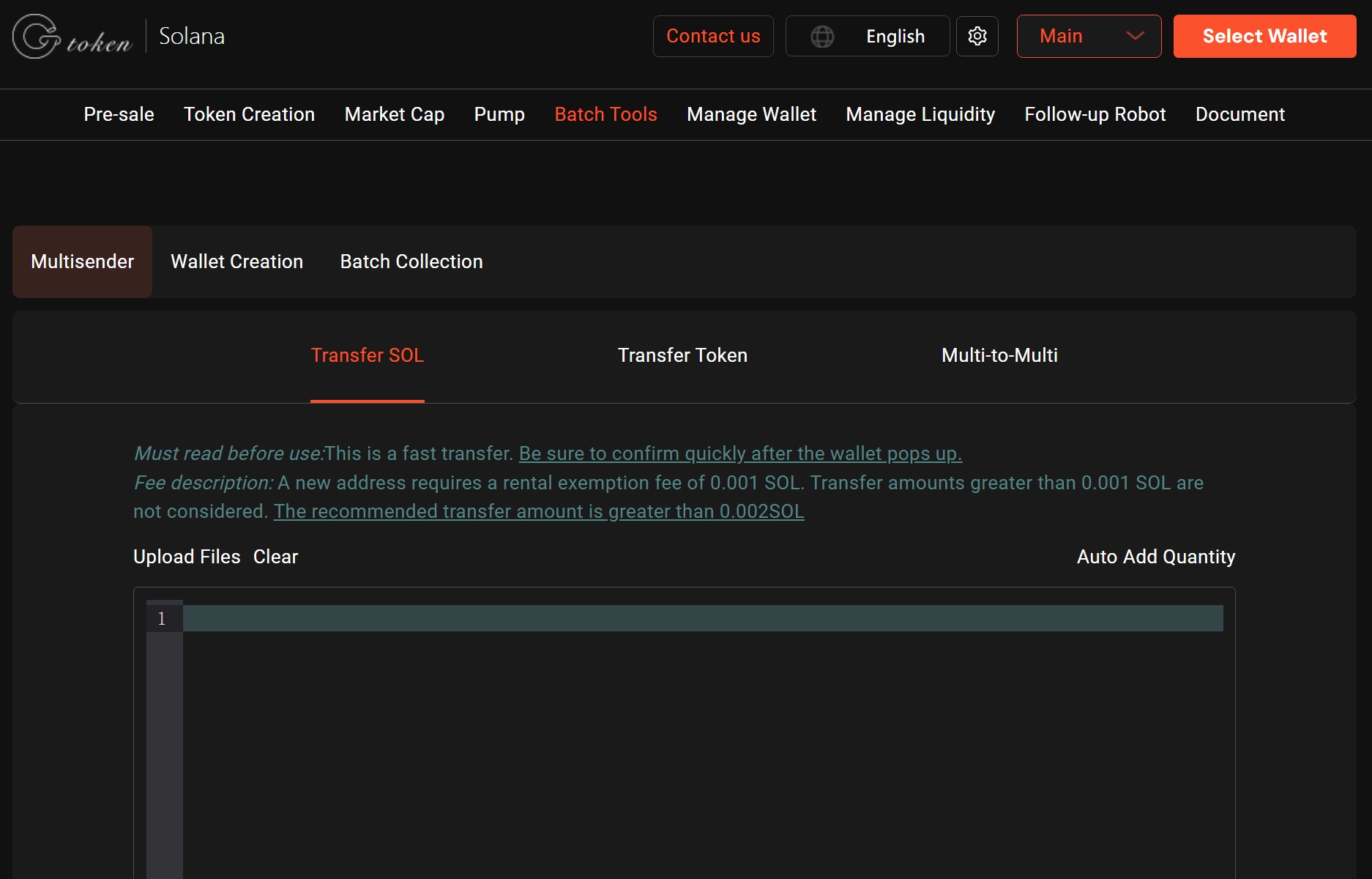
GTokenTool is a no-code solution for mass token distributions, perfect for large airdrops.
5.2 How to Use It?
1. Visit [GTokenTool Airdrop Page](Solana batch transfer, token batch airdrop tool | GTokenTool platform).
2. Connect your wallet (supports Phantom, Solflare, etc.).
3. Upload your airdrop list (CSV format).
4. Select your SPL token and confirm amounts.
5. Pay gas fees (ensure enough SOL in your wallet).
6. Click "Transfer"—the tool handles the rest!
7. Monitor progress in real time.
5.3 Why Choose GTokenTool?
✅ User-friendly – No coding required.
✅ Bulk transfers – Supports thousands of addresses.
✅ Transparent fees – Avoid unexpected failures.
6. Final Thoughts
Airdrops are a great way to grow your community and increase token awareness. Whether you:
- Code your own solution (Python/Shell for devs)
- Use GTokenTool (for no-code simplicity)
you now have everything you need to run a smooth Solana airdrop.