In today's world of increasingly mature blockchain technology, issuing your own virtual currency is no longer the exclusive domain of large tech companies or mysterious geeks. Whether it's for building a project ecosystem, community incentives, or engaging in innovative technical practice, creating a token has become easier than ever. This article will use the one-click token issuance platform GTokenTool as an example to provide a detailed breakdown of the complete process from concept to launch, and answer the questions you care about most along the way.
Part 1: Core Considerations and Preparation Before Issuance
Thorough preparation before hitting the "Create" button is key to success. Issuing a token blindly can not only lead to financial loss but also cause your project to fail before it even starts.
-
Define the Purpose of Issuance:
-
Project Ecosystem Token: Used within your developed DApp, game, or DeFi protocol as a credential for paying fees, purchasing NFTs, or participating in governance.
-
Community Governance Token: Used for a DAO (Decentralized Autonomous Organization), granting holders the right to vote on community proposals.
-
Meme Coin / Cultural Token: Based on community culture or internet trends, focusing on marketing and community building.
-
Asset Tokenization: Representing rights to real-world assets (like real estate, artwork) in the form of tokens.
-
Choose a Blockchain Network:
While Ethereum is the pioneer for token issuance, its high Gas fees deter many individual developers. Today, you have more efficient and economical choices: -
BNB Smart Chain (BSC): Low fees, fast transaction speeds, and a thriving ecosystem make it the top choice for the vast majority of beginners.
-
Polygon (Matic): A Layer 2 scaling solution for Ethereum, also offering low fees and high speed.
-
Solana, Avalanche, etc.: Higher-performance public chains, but with relatively higher technical and community barriers to entry.
-
Prepare Necessary Resources:
-
Cryptocurrency Wallet: This is your key to interacting with the blockchain. We recommend MetaMask. Be sure to securely store your seed phrase and never share it with anyone.
-
Native Cryptocurrency: You need to have a small amount of the blockchain's native cryptocurrency in your wallet to pay for Gas fees associated with the token creation and subsequent transactions. For example, to issue a token on BSC, you need some BNB.
Part 2: Hands-On Guide – Issuing Your Token Using GTokenTool
GTokenTool is a user-friendly online platform that greatly simplifies the process of creating tokens on BSC and Ethereum. Here are the detailed steps:
Step 1: Connect Your Wallet
-
Visit https://www.gtokentool.com.
-
Click the "Connect Wallet" button on the website, select MetaMask, and authorize the connection. Ensure your MetaMask network is switched to the BSC Mainnet or your target testnet.
Step 2: Fill in Token Parameters
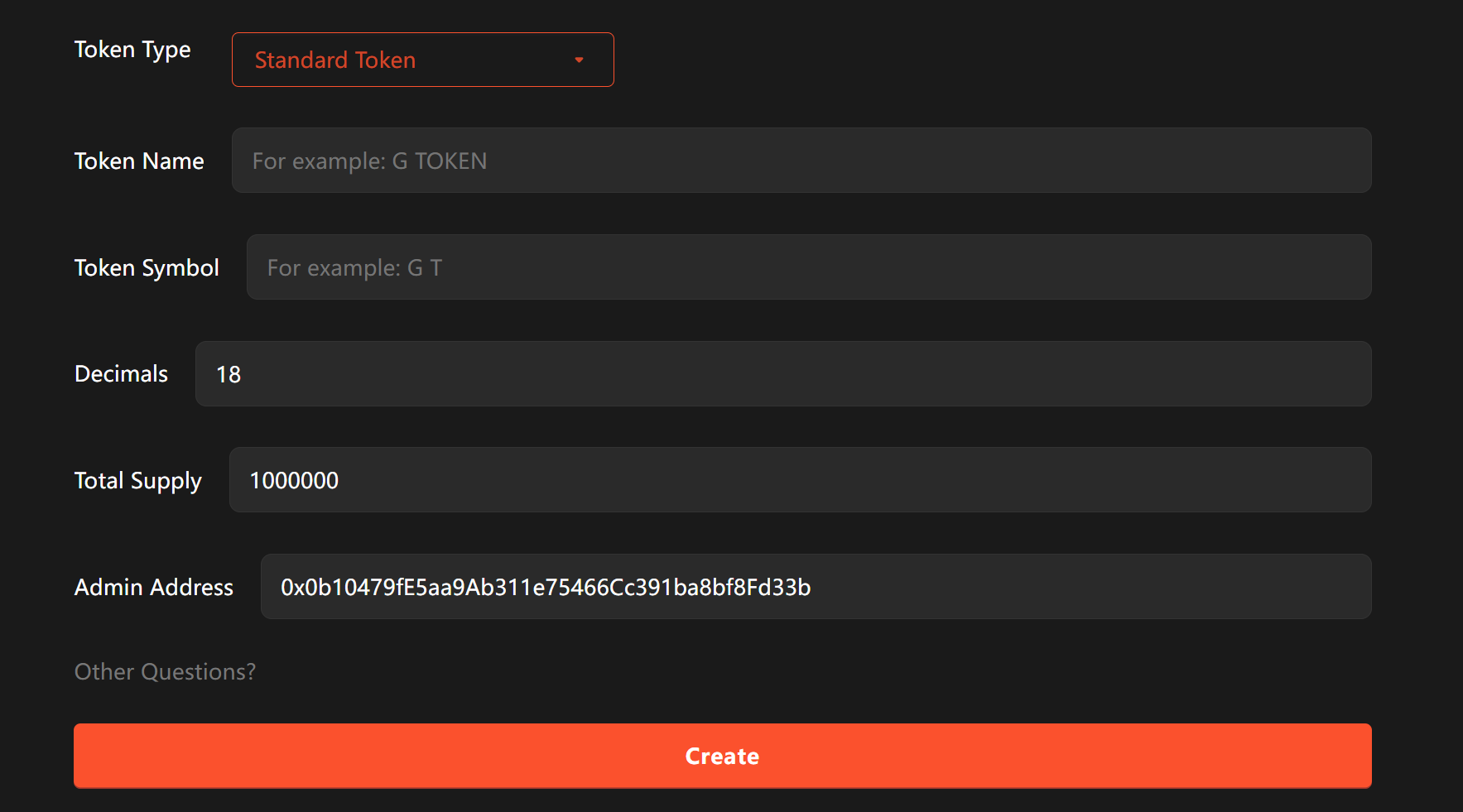
This is the core part; fill in each item carefully:
-
Token Name: The full name of your token (e.g., MyAwesomeCoin).
-
Token Symbol: The abbreviation of your token, usually 3-5 uppercase letters (e.g., MAC).
-
Total Supply: The total number of tokens you wish to create. For example, for 1 million tokens, enter
1000000. -
Decimals: Determines the divisibility precision of your token. It's usually set to 18, which aligns with the standard for ETH and BNB, allowing for very fine transaction units.
-
Token Type: GTokenTool typically offers options like Standard Token and Advanced Tokens (e.g., with dividend, burn mechanisms). For beginners, start with the Standard Token.
Step 3: Advanced Features (Optional but Important)
GTokenTool offers various built-in mechanisms, which are key to making your token more attractive and functional:
-
Transaction Tax/Fee: You can set a certain percentage fee for each transaction. This fee can be automatically distributed to holders (as dividends) or sent to a specific address (for marketing, development fund).
-
Deflationary Model: Set a percentage of tokens to be automatically burned with each transaction, reducing the total supply and potentially increasing the token's value over time.
-
Anti-Bot Mechanisms: For example, set a maximum transaction amount to prevent "whales" from maliciously manipulating the price.
Step 4: Deploy the Token
-
Carefully review all parameters. Once confirmed, click the "Create Token" button.
-
MetaMask will pop up a transaction confirmation window showing the required Gas fee. Confirm and wait for the transaction to be processed and added to the blockchain.
-
After the transaction is successful, you will receive a Transaction Hash. You can use this hash to look up your token contract details on BscScan.com.
Step 5: Verify and Add the Token (Crucial)
-
Copy your token's contract address.
-
In MetaMask, click "Import Token", paste the contract address. Other information (symbol, decimals) should usually auto-populate.
-
Click "Add", and you will see the token you just created in your wallet!
Part 3: After Issuance – Liquidity, Listing, and Marketing
Creating the token is just the first step. A token without liquidity is like a ship without water – it won't go anywhere.
-
Create a Liquidity Pool:
You need to pair your token with BNB (or another mainstream coin) and add it to a Decentralized Exchange (DEX) like PancakeSwap. This requires you to provide an equivalent value of your tokens and BNB as initial liquidity. Once liquidity is added, others can start buying and selling your token. -
Seek Listings:
Beyond PancakeSwap, you can submit your token to major data aggregator websites like CoinMarketCap and CoinGecko to increase exposure. -
Community and Marketing:
Establish communities on Telegram, Discord, and a Twitter account. Regularly post project updates and interact with community members. An active community is the lifeblood of a token.
Frequently Asked Questions
Q&A 1: How much does it cost to issue a virtual currency?
This depends on the network and tools you choose. Using GTokenTool on the BSC network to issue a standard token, the cost mainly consists of two parts:
-
Contract Deployment Gas Fee: This is the transaction fee charged by the blockchain network. On BSC, this fee is very low, typically between $1 - $5, depending on network congestion.
-
Tool Service Fee: The GTokenTool platform charges a service fee.
Therefore, the total cost can be kept under $50 - $100, far less than the often hundreds of dollars required on Ethereum.
Note: This is just the cost of issuing the token. Subsequent steps like creating a liquidity pool and marketing require additional budget.
Q&A 2: Is issuing a virtual currency legal?
This is a crucial legal question. The technology of issuing tokens itself is legal in most parts of the world. However, how you use and market it determines its legality.
-
Compliant Actions: Issuing utility tokens for a specific project ecosystem, community governance, or as membership credentials is usually legal.
-
High-Risk/Illegal Actions: If your token is classified as a "security token" (i.e., investors buy it primarily with the expectation of profit derived from your efforts), then it may fall under the regulation of securities laws in various countries (like the SEC in the US). Issuing securities to the public without registration is illegal. Furthermore, actions like false advertising or "pump and dump" schemes are clearly financial fraud.
-
Recommendation: Consult a professional lawyer familiar with blockchain law before launching any project that might involve public fundraising.
Q&A 3: How can I issue a virtual currency without spending money?
Issuing a fully functional, tradable virtual currency on a mainnet completely "for free" is almost impossible because blockchain network resources (computation and storage) require Gas fees. However, you can do it at very low cost or for practice:
-
Use Testnets: Ethereum, BSC, and others have test networks. You can use free testnet coins to practice issuing tokens on these networks indefinitely, familiarizing yourself with the entire process. This is an excellent and completely free way to learn and test.
-
Find Free Issuance Tools: Some platforms might offer limited-time free token creation events for promotion.
Q&A 4: After issuing the virtual currency, how do I get others to buy it?
This is the key to a token's success – "creating liquidity."
-
Provide Liquidity: As mentioned earlier, you must add your token and BNB to a DEX like PancakeSwap to form a trading pair. Without a liquidity pool, no one can trade it.
-
Information Transparency: Verify your token's contract source code on BscScan and create a detailed project description. Transparency is the first step in building trust.
-
Community Drive: Actively promote your project on social media and crypto forums (like Reddit, Twitter), explaining its value and vision to attract the first wave of community members.
-
Apply for Listings: Submit your token to CoinMarketCap and CoinGecko. Once listed, it gains massive exposure.
Conclusion
Using modern tools like GTokenTool, issuing a technically sound virtual currency has become a relatively straightforward process. However, technical simplicity does not mean success comes easily. The core of a successful token project lies in a solid project concept, a clear token economic model, consistently active community management, and strict adherence to laws and regulations.
Now you possess the knowledge from technical implementation to market operations. It's time to put your ideas into practice and leave your mark in the vast and dynamic world of blockchain. Remember, responsibility goes hand-in-hand with innovation. We wish you the best of luck on your journey to issuing your virtual currency.