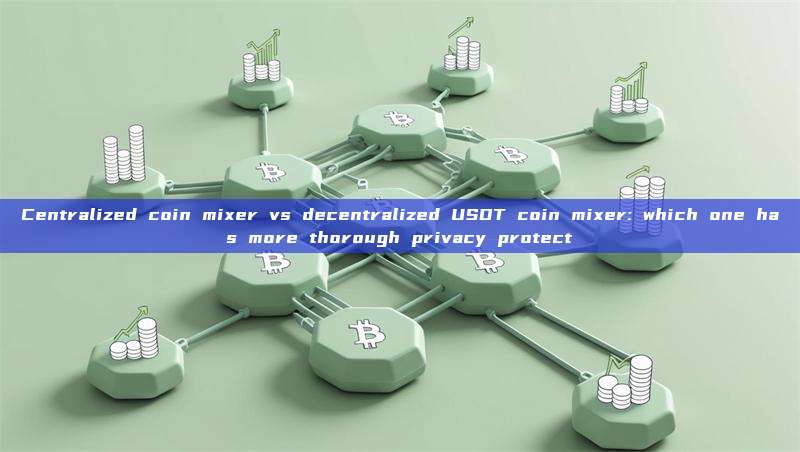
A centralized mixer requires you to hand your funds over to a service provider. Your privacy depends entirely on that provider’s promise not to peek, not to log, and not to sell the data—and you have absolutely no way to verify any of it. A decentralized mixer uses zero-knowledge proofs and smart contracts to mathematically sever any on-chain link between your deposit and withdrawal addresses, without anyone needing to store or protect your personal data. In short, one depends on people; the other depends on math. However, note that USDT itself can still be frozen by the issuer—a risk that exists with either type of mixer, but one that does not reduce the privacy advantage of the decentralized option.
Introduction
Every USDT transaction you make is permanently visible on a public blockchain. Anyone following the trail can connect your addresses, balances, and transaction partners into a crystal-clear web. If you want to break that on-chain surveillance, a “mixer” becomes essential.
But mixers come in two very different flavors: centralized and decentralized. Many people assume they deliver more or less the same privacy. In reality, the two are worlds apart. One leans on “human promise”; the other leans on “mathematical proof.” This guide walks you through how each one works, why the privacy gap is enormous, and what that means for you. We’ll use a simple data comparison table, followed by 8 of the most common questions beginners ask, and finish with a straightforward conclusion. Once you see the mechanics, you’ll understand exactly which tool can truly hide your on-chain footprints—and why.
What Does a Mixer Actually “Mix”?
On blockchains, every USDT transfer is public and traceable from one address to the next. A mixer works by pooling many people’s USDT into a big pot, stirring it up, and then letting everyone pull their coins back out—making it virtually impossible for an outside observer to tell which deposit matches which withdrawal.
Imagine forty people each put an identical $100 bill into a large box. The box is shaken, and then each person reaches in and pulls one bill out at random. An onlooker can see money going in and money coming out, but they can’t pair the two. That’s the basic idea.
The critical question is: who is shaking the box, and are they filming the whole process?
Centralized USDT Mixers: Privacy Based on “Just Trust Me”
A centralized mixer is a website or service run by a company or individual. You visit it, generate an order, and send your USDT to an address it provides. The service receives your coins, pools them with other deposits, and then—using its own internal logic—sends you an equivalent amount from the pool to a fresh withdrawal address you specify.
On-chain, the flow looks like this:
Your address → Mixer’s address → Your new address.
The middle step happens inside the mixer’s private server. The blockchain can’t see it. On the surface, the link between deposit and withdrawal seems to be broken.
Here’s the problem: “the blockchain can’t see it” does not mean “nobody can see it.”
The privacy of a centralized mixer rests on three promises you can never control:
-
No logs are kept. The operator is fully capable of logging every detail: “Address A deposited 1,000 USDT at 1:05 PM. Address B withdrew 1,000 USDT at 1:20 PM.” Even if they claim they don’t log today, you have no way to know if they start tomorrow—or if a law enforcement subpoena forces them to. In past shutdowns of large centralized mixers, investigators extracted complete matching records directly from seized servers.
-
Your funds won’t be stolen. Your coins are fully in the operator’s custody. If they decide to disappear, your money is gone.
-
Your data won’t be leaked. Even if the operator means well, their database can be hacked, sold, or legally compelled. The moment those records are exposed, your privacy is wiped out retroactively.
Centralized mixer privacy is “custodial privacy.” You hand your privacy to a person who tells you they’re closing their eyes. You simply have to trust them.
Decentralized USDT Mixers: Privacy Through Zero-Knowledge Proofs
Decentralized USDT mixers—the most well-known example being Tornado Cash (whose front-end was sanctioned, but whose smart contracts remain permanently unstoppable on-chain)—work on an entirely different principle. You never hand your coins to anyone.
Here’s how the flow works, using a simple analogy:
-
You decide to deposit a fixed denomination, say 1,000 USDT. The system has you generate a random secret, called a “note” or “commitment.” You keep this secret absolutely private.
-
You send 1,000 USDT directly into a publicly accessible smart contract pool that nobody controls. The contract records the deposit and the mathematical “fingerprint” (hash) of your secret together. Anyone can see that someone deposited 1,000 USDT.
-
Later, you want to withdraw those coins to a brand-new address. You don’t provide a username, email, or anything identifying. You simply submit a zero-knowledge proof to the contract. This proof cryptographically demonstrates: “I know the secret belonging to one of the deposits in this pool, so I have the right to withdraw the corresponding amount—but I’m not revealing which deposit it is.”
-
The smart contract verifies the proof mathematically, then sends 1,000 USDT to your chosen withdrawal address. At no point does the contract know, store, or reveal the link between your deposit and your withdrawal.
Notice the crucial difference: Your coins never leave a public, non-custodial smart contract. They are never held by a person or company. The privacy barrier is not a promise; it’s zero-knowledge cryptography. It cannot be reversed, it cannot be correlated, and even the contract itself possesses no mapping of who took what.
This means:
-
There is no server that can log “Address A deposited, Address B withdrew.”
-
Even if someone takes over the nodes running the blockchain, they gain no matching records, because those records were never created in the first place.
-
Unless you, the user, expose your deposit and withdrawal addresses along with your secret (or your IP, browser fingerprint, etc.), the on-chain link is mathematically non-existent.
That is trustless privacy. The foundation shifts from “a person’s word” to “mathematical infeasibility.”
Head-to-Head Comparison: Centralized vs. Decentralized USDT Mixer
The table below breaks down the key privacy and security factors so you can see the difference instantly.
| Comparison Factor | Centralized USDT Mixer | Decentralized USDT Mixer (e.g., Tornado Cash type) |
|---|---|---|
| Trust Model | Must trust the operator completely | Trustless—relies only on cryptography and the smart contract |
| Custody of Funds | Coins are transferred to the operator’s address (full custody) | Coins stay in a non-custodial smart contract; user retains indirect control |
| Deposit-Withdrawal Logs | Operator’s server almost certainly can keep full matching logs | Mathematically impossible to create deposit-withdrawal mapping |
| Privacy Guarantee | Based on operator policy and ethics; can change at any time | Based on zero-knowledge proofs (zk-SNARKs); cannot be broken |
| Anonymity Set | Depends on user count; operator could fake internal records | Derived solely from real on-chain deposits in the pool; unfakeable |
| Censorship & Single Point of Failure | Server, domain, and bank accounts can be shut down; operator may comply with seizure | Smart contract runs permanently on the blockchain; no central kill switch; no front-end needed |
| Registration / KYC | Many require email signup or even KYC, leaving identity trails | No registration, no identity; only a wallet address is needed |
| USDT Freeze Risk | Withdrawal address can be blacklisted by Tether; operator could also freeze | Withdrawal address can still be blacklisted by Tether, but contract cannot freeze deposits; privacy unaffected |
| Exit Scam / Rug Pull Risk | High—operator can steal all deposited funds | Impossible—funds are locked in contract logic; withdrawable anytime with your secret |
| Legal Exposure | Server seizure exposes all historical data and user privacy is instantly destroyed | No server to seize; no operator-held user data; only public, uncorrelated on-chain records exist |
The table makes one thing obvious: on virtually every point that matters for privacy, the centralized option carries a soft spot, while the decentralized option turns that soft spot into a hard technical guarantee.
Frequently Asked Questions (FAQ)
Here are the 8 most common questions beginners ask—answered in plain terms.
1. If a centralized mixer claims it never keeps logs, isn’t that safe enough?
No. First, you cannot verify whether they’re telling the truth. Second, even if they don’t log today, a legal order or a hacker can force logging to begin tomorrow. Third, metadata and traffic analysis can still link your deposits and withdrawals indirectly. “We don’t log” is a verbal promise, not a technical guarantee. A decentralized mixer is incapable of producing those logs—an unbridgeable difference.
2. Does a decentralized USDT mixer really leave zero traces?
It leaves on-chain traces, but the key is that the traces cannot be linked. Your 1,000 USDT deposit is visible, and your 1,000 USDT withdrawal is visible. However, the zero-knowledge proof makes it impossible for anyone to prove those two actions were performed by the same person. The only privacy leaks are from you: if you use the same username on a forum for both addresses, or your IP address ties them together off-chain. The mixer itself stays clean on-chain.
3. USDT can be frozen by Tether. Does using a decentralized mixer still make sense?
Absolutely—and this is exactly where the decentralized advantage shines. Tether can blacklist addresses involved in illicit activity. In a decentralized mixer, your deposit goes into a contract nobody controls; Tether cannot freeze the funds inside the pool. When you withdraw to a brand-new address that has no direct history of blacklisted behavior, that new address is clean. The crucial point: Tether’s review is address-based, not person-based. The mixer breaks the link to your old, potentially tainted addresses. A centralized mixer, however, might actively cooperate with Tether or be forced to report your new address, getting it flagged much faster.
4. Tornado Cash was sanctioned. Can I still use a decentralized USDT mixer?
Yes. The sanctions primarily targeted the front-end website and certain developer tools. The core smart contracts deployed on Ethereum, BNB Chain, and others are permanent and cannot be taken down. Users with basic technical know-how can interact with the contract directly, and community-built alternative front-ends exist. This is the core strength of a decentralized mixer: there is no company to shut down and no server to unplug.
5. Are decentralized mixers too technical for beginners?
The barrier is definitely higher than a point-and-click centralized website. You need to understand what a secret note is, how to save it safely, and you’ll follow more steps than just copy-pasting an address. However, when a user-friendly front-end is available, the process is fairly streamlined: select coin and denomination, deposit, save your note (a string or file), and later use that note to withdraw. A beginner who follows a clear guide carefully can manage it. The difficulty is roughly on par with setting up a hardware wallet for the first time.
6. . Does a bigger anonymity set make a decentralized mixer better?
Yes. The anonymity set is the number of deposits of the same denomination sitting in the pool. The larger that number, the larger the crowd you’re hiding among when you withdraw, making it exponentially harder to single you out. A centralized mixer can claim a huge anonymity set, but because it secretly holds the real mapping, that size is meaningless. In a decentralized mixer, the anonymity set is real, verifiable, and cannot be faked.
7. Are centralized mixers completely useless? When might someone still choose one?
Not completely useless. If you’re only trying to block casual snooping, your adversary isn’t a sophisticated firm, and you trust a well-known mixer, a centralized service can be convenient for small amounts. But you have to go in with eyes open: your privacy is built on sand. For large amounts, long-term holding, or high-risk environments, a centralized mixer is essentially a glass door.
Conclusion
When you choose a centralized USDT mixer, you build your privacy on the operator’s character, tech security, and willingness to resist legal pressure. That foundation can crack at any moment, and you likely won’t hear it happen until it’s far too late. A string of mixer shutdowns, data leaks, and exit scams over the past decade has proven just how fragile that model is.
A decentralized USDT mixer replaces that shaky human foundation with smart contracts and zero-knowledge proofs—anchoring your privacy in math and decentralized consensus. It removes the most unstable element: the human in the middle. It guarantees no logs, no correlation, and no custody handover. Yes, the user experience is a bit more involved and you must safeguard your own secret note, but what you get in return is ultimate sovereignty over your financial privacy.
So, back to the original question: Which offers more complete privacy protection?
The answer is emphatically clear: a decentralized USDT mixer.
One is standing in the dark while someone whispers, “Don’t worry, I’m not looking.” The other turns the whole room into a lightless, camera-free space where even the room itself is blind. Which one you pick determines how far your privacy can actually go.