In the fast-paced world of Solana blockchain, memecoins and DeFi projects are popping up like mushrooms after a rain. Solana's high throughput, low fees, and lightning-fast confirmations have made it the go-to platform for crypto enthusiasts and project teams. But for new tokens, managing market cap is often the make-or-break factor. Wild price swings, low liquidity, and lackluster trading volume are common headaches—how do you efficiently control market cap, stabilize prices, and boost trading activity? Enter the Letsbonk market cap bot, the perfect weapon for this battle. As an extension of the Jupiter (JUP) aggregator, Letsbonk is tailor-made for tokens on Solana, offering features like batch trading, pumping, dumping, and volume washing to help project teams or traders nail precise market cap control.
In this hands-on, tutorial-driven guide, we'll dive deep into Letsbonk's mechanics, features, and how to use it, so you can get up to speed fast and become a market cap wizard in the Solana ecosystem.
The Origins and Core Value of Letsbonk
The Letsbonk market cap bot didn't just appear out of thin air—it was born from the desperate need for efficient trading tools in the Solana ecosystem. Jupiter, the top DEX aggregator on Solana, is famous for its optimized routing algorithms and low-slippage trades. Letsbonk is its dedicated market cap management module, laser-focused on batch operations. In simple terms, it's a front-end automation tool that supports single-route mode (SOL pools only for SOL trades, USDC pools only for USDC trades) and works with all pool types. That means no matter if your token is based on the SPL standard or some variant, as long as there's a liquidity pool supported by Jup, it plugs right in seamlessly.
Why do we even need a bot like this? In Solana's "degen" culture, new tokens often launch to instant dumps or total radio silence. Manual trading is slow and clunky—you'll miss the boat every time. Letsbonk handles bulk wallet imports, parameterized setups, and real-time log monitoring to deliver "one-click pumps, dumps, or volume washes." Its core value boils down to three things: first, supercharged efficiency with multi-wallet parallel ops; second, risk management via slippage, gas, and interval settings to dodge bad trades; and third, full transparency with real-time pool IDs, prices, and tx hashes for easy on-chain verification.
From an ecosystem perspective, Letsbonk isn't just a tool—it's a shining example of Solana's decentralized ethos. It's open-source, secure, and never stores your private keys; everything runs in your browser front-end. This lets project teams confidently use it for market making, while retail traders can tinker on a small scale. Picture this: a fresh memecoin drops, and in minutes, you inject liquidity, pump the price, and fake some volume with Letsbonk—bam, you've got the community's eyes on you. Not sci-fi, just straight-up reality. Of course, it's not a "sniper bot" like PEPE BOT for ultra-fast launches—it's built for mid-to-long-term market cap management.
Feature Breakdown: From Pumping to Volume Washing—A Full Toolkit
Letsbonk packs a ton of features, all revolving around four trading modes: pumping (buy to drive up price), dumping (sell to push down price), volume washing (random buys/sells to fake activity), and anti-sandwich volume washing (optimized to dodge sandwich attacks). Each mode comes with fine-tuned parameters, giving you total control like it's an extension of your hand.
First up, pump mode is the project team's favorite "launch engine." Set a target price above the current one, input SOL amounts (fixed, random, or all-in), and the bot batches buys to rocket the market cap. Key params include slippage (10%+ for new launches to handle volatility), execution intervals (second-level delays to avoid bunching up), and gas fees (default 0.000175 SOL, fast mode 0.00035 SOL). Flip on "smart slippage," and if slippage spikes too high, it skips the trade to save gas. For example, with 10 wallets each holding 0.1 SOL, targeting 1.5x current price and 5-second intervals—Letsbonk rolls through them sequentially, steadily pumping.
Dump mode flips the script for "shakeouts" or testing downside pressure. Target price below current, amounts in token quantities. It supports "dump all" for one-click liquidation, ignoring slippage. Super handy for teams cashing out gains or rebalancing positions. Params mirror pump mode, but with sell percentages and minimum thresholds (e.g., hold at least 1,000 tokens before selling) to avoid over-dumping.
Volume wash mode mimics real market buzz, with customizable buy/sell probabilities (e.g., 60% buy, 40% sell). Set buy SOL ranges and sell token percentages. Wash rounds cap total cycles (one full loop across all wallets counts as one), and enabling multi-threading speeds things up with parallel wallet action—but it bumps failure rates a bit. This is gold for inflating TVL and rankings; tons of projects use it to stage "organic" growth.
Anti-sandwich volume wash is pro-level stuff, countering MEV sandwiches (where miners front-run your trades). It randomizes buys/sells, pairing with Ultra routes (0.5% fee for high priority) and GMGN routes (up to 80% slippage cap) to keep trades safe from hijacks. Params include minimum sell thresholds to avoid forced sells on tiny holdings and balanced buy ranges.
On top of that, Letsbonk integrates custom RPCs (defaults to public nodes—grab a private one for speed), auto/manual DEX selection (defaults to Bonkbot), and a logging system. Real-time views of pool IDs, prices, and tx hashes, with one-click jumps to Solscan for verification. These pieces together turn Letsbonk from a basic bot into a pro dashboard.
Step-by-Step Guide: From Zero to Pro Setup
Getting started with Letsbonk is a breeze—just grab a computer or phone, wallet private keys, token balances, and a splash of SOL for gas. Here's the full walkthrough based on the official docs, zero barriers.
Step 1: Connect Your Wallet
Head to the Jup market cap page: https://sol.gtokentool.com/market/jupMarket. Hit "Connect Wallet" in the top right and pick Mainnet. Supports Phantom, Solflare, and other big ones—make sure you've got at least 0.01 SOL to start.
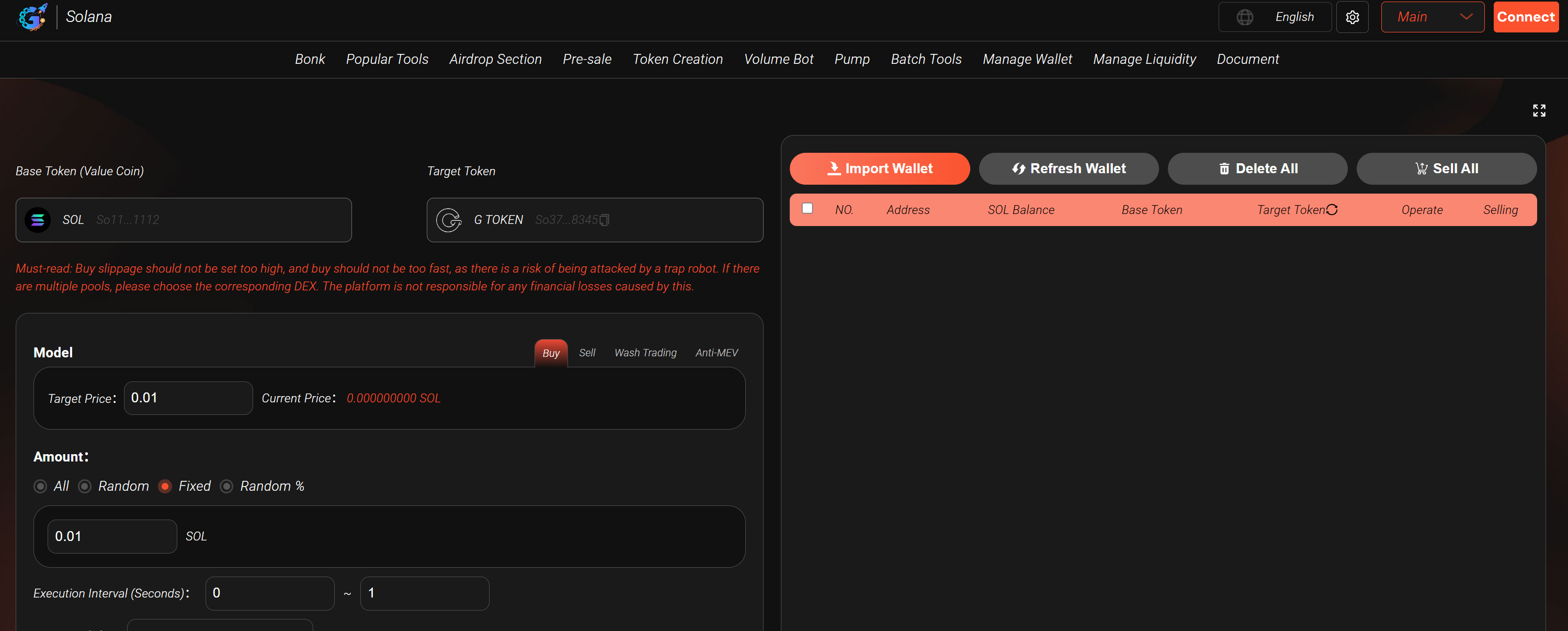
Step 2: Input Token Info
Paste the target token's contract address in the search bar, select it, then choose your base token (SOL or USDC). The page auto-loads current price and liquidity pools. Heads up: No support for Token-2022 tokens—if no pools show, that's likely why.
Step 3: Query Pool ID
Scroll to the bottom log area for pool IDs and live prices. Hit "Clear Logs" to reset, or "Query Pools" to refresh. This step's crucial for nailing the right routes.
Step 4: Import Bulk Wallets
Click "Import Bulk Wallets" and paste your private key list (one per line, up to 100). It auto-queries balances—tap "Refresh Wallets" to update. Check 'em off, then "Dump All" for a full clear-out or single "Sell/Delete." Target token balances have refresh icons for easy tracking. Pro tip: Test with fresh wallets to avoid key leaks (front-end only, but better safe).
Step 5: Configure Parameters
Tweak based on mode:
-
Trade Mode: Pick pump/dump/wash/anti-sandwich.
-
Target Price: Above current for pumps, below for dumps.
-
Amounts: SOL for buys, token qty for sells—fixed/random/all.
-
Probabilities & Thresholds: For wash mode, set buy/sell odds; min sell threshold to dodge tiny holdings.
-
Intervals & Slippage: 5-30 seconds apart; 15%+ slippage for fresh launches.
-
RPC & Gas: Custom RPC for speed boosts, fast gas mode.
-
Routes & DEX: Ultra/GMGN for priority; auto-DEX to cut fails.
Enable multi-threading and smart slippage for smoother runs. Set wash rounds for total cycles—auto-stops when done.
Step 6: Launch and Monitor
Select wallets, smash "Start." Logs roll live with every trade detail. When it's over, click hashes for Solscan or refresh balances to confirm. Pump example: 10 wallets, 0.05 SOL per trade, 1.2x target, 20% slippage, 10-sec intervals—market cap could double in minutes.
Caveats and FAQ
Letsbonk is user-friendly, but watch for risks. First, single-route limits: No cross-trading SOL/USDC pools. Second, volatile new launches? Crank slippage to 20-50% to avoid fails. Most glitches come from low balances, slow nodes, unqueried pools, or skimpy gas—double-check params. Multi-threading has a slight failure bump; stick to 100 wallets max for stability. And keys? Platform doesn't store 'em, but use burners anyway.
Common FAQs:
Can't find pools? Token-2022 unsupported—switch to standard SPL.Anti-sandwich wash counts per address or total? Total across all—wallets cycle until hit (buy + sell = one count).Good for sniping launches? Nah, not built for that—it's for controlled market making, not launch rushes.Key security? Front-end only, zero storage.
Wrapping Up: Master Your Market Cap and Ride the Wave
The Letsbonk market cap bot, with its simple, smart, and secure vibe, is a no-brainer for Solana project teams. It's more than a tool—it's a bridge to innovation. In crypto, opportunities flash by in seconds; wield Letsbonk right, and you'll shift from reactive trader to market boss. Remember, investing's risky—play smart. Dive in, unlock Solana's endless potential, and let's go!
If you have any questions or uncertainties, please join the official Telegram group: https://t.me/GToken_EN