DeFi, or Decentralized Finance, is a financial ecosystem built on blockchain technology. It uses smart contracts to automatically execute services like lending, borrowing, and trading without middlemen like banks or brokerages. Simply put: The blockchain acts as a transparent, shared "public ledger," and smart contracts act as an "automated digital escrow agent." Together, they allow anyone with an internet connection to move and manage assets using code rather than trust in a corporation.
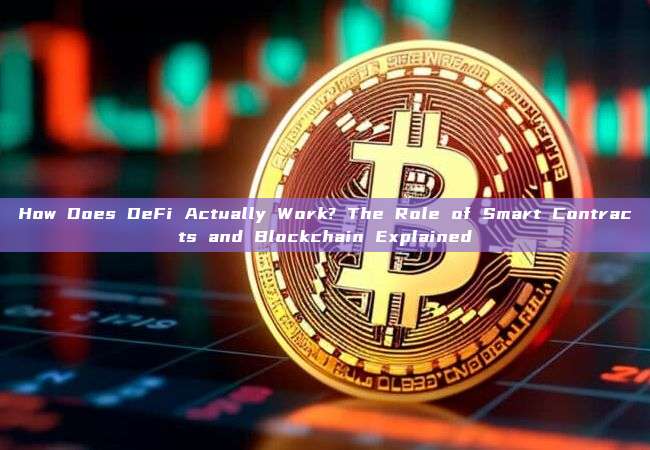
The following guide breaks down exactly how these two technologies power DeFi, complete with data comparisons and a detailed Q&A for beginners.
1. Introduction
Traditional finance relies on a massive system of intermediaries. Depositing money requires a bank. Transferring money requires a clearinghouse. Trading stocks requires a broker and an exchange. An international wire transfer can take 3 to 5 business days, and every stop along the way takes a small cut.
DeFi attempts to redesign this system using code and blockchains. In the DeFi world, there is no bank branch, no brokerage desk, and no clearinghouse. There are only smart contracts running on a blockchain executing financial logic. All a user needs is a crypto wallet to participate in global lending, trading, and yield generation—regardless of where they live or what their credit score looks like.
But how does it actually function? What specific roles do the blockchain and smart contracts play? Let's dive in.
2. Layer One
To understand DeFi, you first need to understand the foundation it's built on: the blockchain.
What is a blockchain? Think of it as a public, tamper-proof digital spreadsheet. A traditional bank maintains its own private ledger and you trust them to keep it accurate. On a blockchain, the ledger is maintained by thousands of computers (nodes) around the world. Every transaction must be verified by a majority of the network, and once it's written, it cannot be altered or erased by a single party.
The Blockchain's Role in DeFi:
-
Settlement Layer: Every DeFi action—whether it's a loan, a swap, or a deposit—is permanently recorded on the blockchain and validated by the network. This ensures radical transparency and non-repudiation.
-
Asset Layer: All assets in DeFi (like ETH, USDC, DAI) are essentially tokens on a blockchain. They represent a claim on a specific value.
-
Trustless Infrastructure: You don't need to trust a CEO or a corporation. You only need to trust the mathematics of the consensus mechanism and the network's rules.
A Key Nuance: The blockchain ensures the "history book" is accurate and fair, but it doesn't do anything active. It's just a record. So who executes the actual financial services? That's where smart contracts come in.
3. Layer Two
If blockchain is the skeleton of DeFi, smart contracts are the brain and the hands.
What is a smart contract? A smart contract is a program deployed on the blockchain. It’s a piece of code that says: "If X happens, then automatically execute Y." No human intervention required. For example, a simple contract might say: "If User A sends 1 ETH to this address, automatically send the NFT to User A." There's no lawyer, no notary, no middleman.
The Smart Contract's Core Roles in DeFi:
-
Automated Execution: In a lending protocol like Aave, the smart contract automatically matches lenders with borrowers, calculates interest dynamically, and liquidates collateral if the market crashes. In a decentralized exchange (DEX) like Uniswap, the contract automatically swaps tokens and adjusts the price based on the pool balance. All of this runs 24/7.
-
Custody of Funds: When you deposit money into a DeFi protocol, those funds are locked in the smart contract. The contract's code dictates exactly how that money can be used and under what conditions it can be withdrawn. In theory, if the code is secure, nobody—not even the project's founders—can unilaterally run off with the money.
-
Eliminating Trust Costs: In traditional finance, you pay fees to trust that the bank won't lose your money or that the exchange won't front-run your trade. In DeFi, trust is replaced by code verification. You don't have to trust a person; you just have to trust the open-source, immutable contract you're interacting with.
A Relatable Analogy: Imagine a vending machine for finance. The blockchain is the security camera recording everything that happens. The smart contract is the internal mechanism of the machine. You put in a token (collateral), and the machine automatically dispenses a soda (a loan). It doesn't need a cashier, it doesn't check your ID, and it never closes. As long as the machine isn't broken (i.e., the contract has no bugs), it will follow its programming perfectly every time.
4. Core DeFi Use Cases
Now that we understand the layers, let's look at how blockchain and smart contracts work together in real-world applications.
1. Decentralized Exchanges (DEXs)
Take Uniswap as an example. Its core mechanism is the Automated Market Maker (AMM) . Users deposit two tokens (e.g., ETH and USDC) into a shared "liquidity pool." When someone wants to swap ETH for USDC, the smart contract looks at the ratio of tokens in the pool, calculates the price automatically, and executes the trade instantly. There is no order book and no matching engine.
Context: As of early 2026, monthly DEX trading volume regularly exceeds $1 trillion.
2. Lending Protocols
Take Aave. Lenders deposit tokens into a pool to earn passive yield. Borrowers can take out loans by providing other assets as collateral. The smart contract adjusts interest rates algorithmically based on supply and demand—if everyone wants to borrow USDC, the rate goes up to attract more lenders. If the value of a borrower's collateral drops too low (below the "health factor"), the smart contract automatically liquidates a portion of the collateral to protect the lenders. No collections agency, no court order.
Context: Aave's Total Value Locked (TVL) exceeds $54 billion, representing about 59% of the DeFi lending market share.
3. Stablecoins
Stablecoins are cryptocurrencies pegged to an external asset, usually the US Dollar. They are the "cash" of the DeFi ecosystem. Take DAI. Users deposit volatile assets like ETH into a smart contract (MakerDAO), and the contract automatically mints a corresponding amount of DAI for the user. The entire monetary policy is governed by code and community voting, not a central bank.
4. Yield Aggregators and Derivatives
More complex protocols like Yearn use smart contracts to move user funds between different lending and trading protocols automatically, chasing the highest yield available. Derivatives platforms like GMX allow for leveraged trading, where smart contracts manage the complex risk and collateral requirements of futures contracts.
5. Data Comparison
The following table offers a direct, apples-to-apples comparison of the two systems based on current market conditions:
| Metric | Traditional Finance (TradFi) | DeFi (Decentralized Finance) |
|---|---|---|
| Transaction Speed | ACH/Bank Transfer: 1-3 days; Stock Settlement: T+1 | Seconds to minutes (varies by blockchain network congestion) |
| Cost Structure | Multi-layer fees (bank fees, interchange, FX spread, brokerage fees) | Network fees only (Gas fees); no intermediary rent extraction |
| Accessibility | Requires bank account, credit check, KYC/AML verification | Requires an internet connection and a self-custody wallet |
| Operating Hours | Business hours, closed weekends/holidays | 24/7/365 |
| Transparency | Ledgers are private, proprietary information | All transactions are publicly verifiable on-chain |
| Primary Security Risk | Counterparty risk, bank insolvency, fraud | Smart contract bugs, private key loss, phishing attacks |
| User Control | Custodial (Bank controls the asset) | Self-Custody (User holds the private key) |
| Market Size (2026) | Global finance: Hundreds of trillions USD | DeFi Total Value Locked (TVL): ~$130B - $140B |
| Regulation | Mature, well-defined legal frameworks | Evolving, fragmented, and uncertain (regulatory risk) |
| Customer Support | Yes, 1-800 numbers, branches, and ombudsman | None. The code is law; support is community-driven. |
6. Questions
Q1: Is DeFi really completely decentralized?
A: It's a spectrum, not a binary switch. Technically, the backend (settlement and execution) is decentralized because it runs on a blockchain rather than a private server. However, many DeFi projects have centralized components—like a core development team that holds "admin keys" to upgrade the contract or a small group of early investors holding most of the governance tokens. Additionally, many users access DeFi through centralized exchanges (like Coinbase) rather than self-custody wallets. A 2026 PwC report highlights that regulators are increasingly viewing this as a hybrid space, applying traditional market rules to the front-end interfaces of DeFi.
Q2: Is earning yield in DeFi safe?
A: DeFi offers real yield opportunities, but risk and return are inextricably linked. By 2026, yields have normalized. For example, the annual percentage yield (APY) for lending USDC on Aave hovers around 2.6%, which is actually slightly lower than the 3.14% offered by some traditional brokerage cash sweeps (like Interactive Brokers). If you see a project advertising "1,000% APY," it is either a temporary incentive paid out in a token that will rapidly lose value (inflation), or it's a Ponzi scheme. The Golden Rule: Stick to protocols that have been audited by top-tier firms (like Trail of Bits, CertiK) and never invest more than you are prepared to lose entirely.
Q3: Can smart contracts be hacked? Will I lose my money?
A: Yes. This is the single biggest risk in DeFi. Smart contracts are code, and code has bugs. Recent history is littered with examples: In April 2026 alone, the Drift Protocol on Solana suffered a ~$280M exploit, and the Hyperbridge cross-chain protocol had a vulnerability that allowed the minting of 1 billion fake tokens. Due diligence is essential. Look for protocols that are open-source and have multiple independent security audits. Even then, there is always residual "tail risk."
Q4: Do I need to know how to code to use DeFi?
A: Absolutely not. The user experience has improved dramatically. Using a wallet like MetaMask or Phantom is about as complex as using an online banking app. You click a button to "Deposit" or "Swap" and sign the transaction with your wallet. However, understanding why a transaction costs $50 in gas fees or what you are actually signing requires a baseline of financial and technical literacy. Start small ($20-$50) on a low-cost network like Arbitrum or Base to learn the ropes.
Q5: What are "Gas Fees"?
A: A gas fee is a transaction fee paid to the network validators (miners or stakers) for processing your transaction on the blockchain. Think of it like a postage stamp or an Uber surge price. On a busy network like Ethereum mainnet, a simple swap might cost $30. On a Layer 2 network like Arbitrum or a high-speed chain like Solana, that same swap might cost $0.002. Gas fees are a critical cost factor in DeFi profitability, especially for smaller transactions.
Q6: What happens if I lose my wallet's "Seed Phrase"?
A: Your funds are gone forever. This is the double-edged sword of self-custody. In TradFi, if you forget your password, the bank can reset it because they control the ledger. In DeFi, you are the bank. The 12 or 24-word seed phrase is the master key to your vault. If you lose it or share it with a scammer, there is no "Forgot Password" button and no FDIC insurance to make you whole. Rule #1 of DeFi: Protect your seed phrase with your life. Write it down on paper. Never store it digitally.
Q7: Is DeFi legal? What does the SEC think?
A: Regulation is the wild card. As of April 2026, the U.S. SEC has released new policy frameworks that offer a more accommodating path for DeFi interfaces that do not take custody of user funds. Meanwhile, the EU's MiCA framework is fully in effect, setting clear rules for stablecoin issuers and crypto asset service providers. The trend is moving from "Can we shut this down?" to "How do we apply existing investor protection laws to this new technology?" It remains a patchwork of rules depending on your jurisdiction.
Q8: Will DeFi merge with traditional finance?
A: It's already happening. 2026 has shown a clear convergence. DeFi has built an incredibly efficient back-end settlement layer at a fraction of the cost of legacy banking systems. Traditional finance has the customers and the regulatory licenses. The future likely involves a hybrid: Banks using DeFi "rails" for settlement while maintaining compliance on the front-end, or regulated stablecoins integrating directly with checking accounts.
7. Conclusion
The logic of DeFi is straightforward: Blockchain provides the transparent, immutable record, and smart contracts provide the automated execution. Together, they create an open financial system that operates without needing to trust a centralized third party.
However, it's crucial to remain sober about the risks. Smart contract hacks remain a real and present danger. High yields often hide high risk. And the regulatory landscape is still being drawn.
For newcomers, the path forward is clear: Learn first, invest small, prioritize security. Protect your private keys as if they are the keys to a safe deposit box. Stick to battle-tested, audited protocols. And never, ever invest money you cannot afford to lose.
DeFi is more than just new technology; it represents a new philosophy—the idea that financial infrastructure should be open, permissionless, and accessible to everyone with an internet connection. That freedom comes with immense opportunity, but also with total personal responsibility.